
Transcultural Modernism: Artistic Interchange between Denmark and Japan, 1945-1970 (TraM)
The project applies a transcultural approach in analysing Danish and Japanese art histories of modernism and contextualising these histories into global networks of interchange. The project has three interconnected perspectives: Transcultural aesthetics, transcultural archives, and transcultural debates.
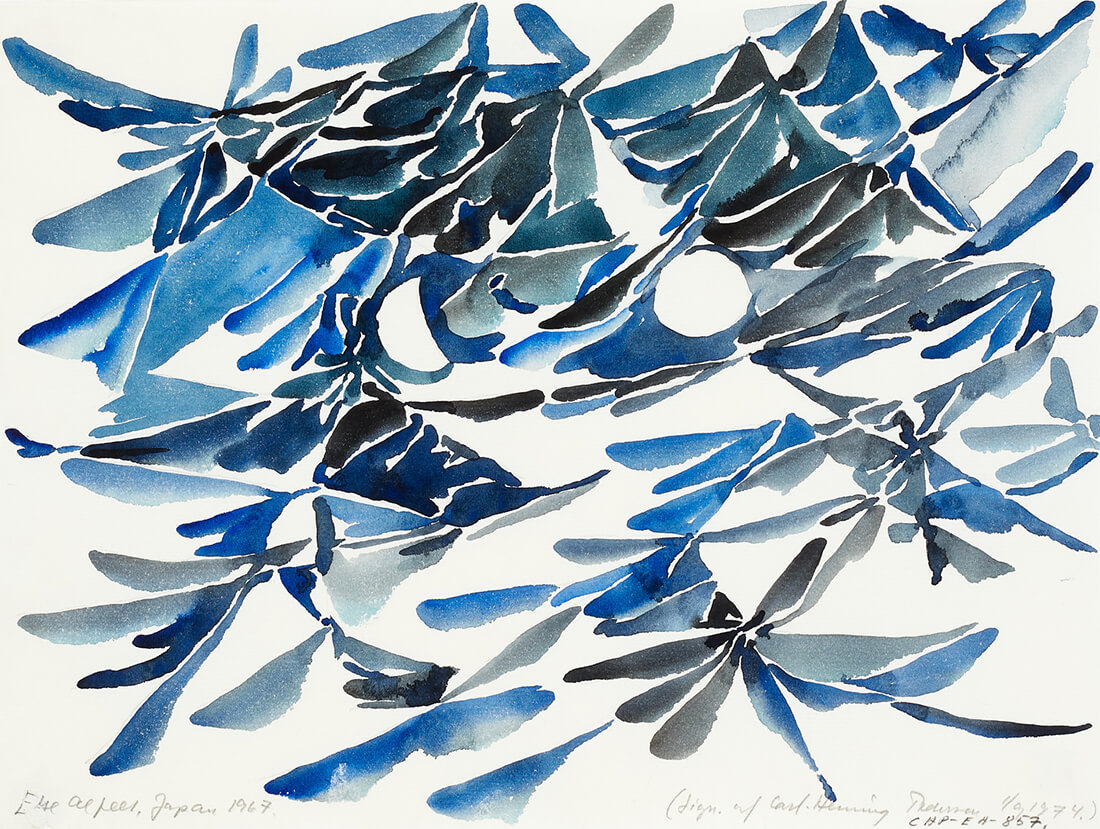
By applying an overall framework of transculturation, the TraM project aims at rethinking the notion of cultural appropriation in modernist art history. With case studies focusing on the interaction between Denmark and Japan, TraM will use archival material to map out the complex flows of artefacts, information, ideas, and personal relationships between the two countries. This selective incision is made in order to dive into specific archival and artistic materials and argue for generalizations through close empirical readings. The TraM project applies a cross-disciplinary approach that intersect art history, Japan areas studies, and studies of culture.
The TraM project applies an overall theoretical framework of transculturation. During the 1990s, the concept of transculturation was activated in the context of globalisation, postcolonialism and geopolitical transitions. Common for a transcultural approach is to challenge the basic epistemological framework that understands cultures as separate and autonomous “islands”. Instead, a transcultural approach emphasizes the hybrid properties of cultural forms as a fundamental condition for present day cultures, and thus calls for a reconceptualisation of the concept of culture itself.
In the field of art history, a transcultural approach provides new perspectives on the issues of cultural appropriation within art works, genres, or styles that flourish under terms such as “influence”, “inspiration”, “imitation”, or “copy”. One such example is the art historical term Japonisme, defined as the study of the influence of Japanese art on Western art, and operating under the assumption of two distinct and separated cultures. The TraM project will avoid the term Japonisme and instead look at the transformative potential in the processes of interchange: how did cultural encounters contribute to the transformation of the cultures involved, and how did new hybrid forms emerge from that interchange?
In the TraM project, the transcultural approach is closely linked to modernism and avant-garde art forms. Recent art history research has pointed out how the narrative of modernism as a quintessentially European movement has constructed non-European modernism as derivative or second-rate. The asymmetries between Western and non-Western art have led to instances of self-orientalization in Asian countries, in which national or cultural traditions are highlighted as signs of “authenticity”. A transcultural approach calls for dissolving the dichotomy of Western and non-Western modernisms altogether. This will undermine the myth of non-Western “belatedness” and instead see modernism as concomitant and reciprocal processes of interactions of already hybrid cultural forms.
Within the field of art history, the TraM project and its outputs will contribute to a global art history by providing a new and original perspective on transcultural interchanges between Denmark and Japan. The project contributes to a broader epistemological shift from a Eurocentric perspective to that of a global art history.
The project has three interrelated perspectives
Transcultural aesthetics
Theorising transcultural aesthetics as a means to establish frameworks of reciprocity and symmetry in the interchange of artistic practices between Danish and Japanese modernism in the postwar period. It includes issues of representation and abstraction in visual arts, notions of universalism and primitivism, aspects of metaphysics and spirituality, as well as questions pertaining to taxonomies and aesthetic hierarchies.
Transcultural archives
Exploring physical and digital archives and collections for documentation that attests Danish and Japanese artists’ interchange with each other. This will map the infrastructures and temporary locations of travelling artefacts, exhibitions, publications, and other types of material as a foundation for transcultural interchange. Analysing and contextualising archival content across nations, institutions, and genres provides the empirical body of evidence and testing ground for the theoretical developments in the project.
Transcultural debates
Using research outputs, public events and dissemination to promote a transcultural perspective in the current public and academic debates on decolonial art history as a means to highlight reciprocity and deminish prejudice concerning representation of East Asian culture in Denmark. Research exchange during workshops and conference helps consolidate a transcultural art history on an international level.
The TraM project has an advisory board of renowned international scholars in the field of transcultural studies and modern and avant-garde art in global context. The Advisory Board brings together representatives from various Danish and international research networks and museum institutions to contribute to developing the TraM project.
- Anne-Louise Sommer (Design Museum Denmark)
- Asato Ikeda (Fordham University)
- Dorthe Aagesen (SMK)
- Eugenia Bogdanova-Kummer (Sainsbury Institute)
- Hiroko Ikegami (Osaka University)
- Jens Tang Kristensen (Museum Sønderjylland)
- Ming Tiampo (Carleton University)
- Monica Juneja (Heidelberg Universität)
- Mårten Snickare (Stockholm University)
- Sara Duborg Døssing (HEART Herning Museum of Contemporary Art)
- Tania Ørum (University of Copenhagen)
Borggreen, Gunhild Ravn, Mette Højsgaard and Kristine Sandal Hansen (2026), ”Introduction”, in Rethinking Transcultural Interactions in Visual Art, eds. Gunhild Ravn Borggreen, Mette Højsgaard and Kristine Sandal Hansen (De Gruyter).
Højsgaard, Mette (2026), ”In Search of a Common Ground: Morita, Jorn, Alechinsky and the Il Gesto Exhibition”, in Rethinking Transcultural Interactions in Visual Art, eds. Gunhild Ravn Borggreen, Mette Højsgaard and Kristine Sandal Hansen (De Gruyter).
Borggreen, Gunhild Ravn (2026), ”Ecofeminism as Transcultural Approach: Else Alfelt and Daoism”, in Rethinking Transcultural Interactions in Visual Art, eds. Gunhild Ravn Borggreen, Mette Højsgaard and Kristine Sandal Hansen (De Gruyter).
Borggreen, Gunhild Ravn (2026), “Transkulturel modernisme i dansk kunsthistorisk forskning”, in Genfortællinger: En hvidbog om at skrive dansk kunsthistorie i dag, red. Toke Riis Ebbesen, Dansk Kunsthistorikerforening.
Borggreen, Gunhild (2025), 書が結んだ友情——森田子龍とアスカ・ヨーンをめぐる交流, ”Sho ga musunda yūjo: Morita Shiryū to Asugā Yōn o meguru kōryū” (Friendship through calligraphy: Friendship through calligraphy: Morita Shiryū, Asger Jorn, and their networks),『美術フォオルム21』Bijutsu Forum 21, 25.
Borggreen, Gunhild (2025), 森田子龍とアスカ・ヨーン, “Morita Shiryū to Asugā Yōn” (Morita Shiryū og Asger Jorn), translated by Art Translators Collective, 『墨人』Bokujin 749.
Borggreen, Gunhild Ravn (2024), Begærets billeder: Visuel kultur i japanske træsnit (Images of desire: Visual culture in Japanese woodblock prints), Copenhagen: Strandberg Publishing.
Borggreen, Gunhild Ravn, and Asato Ikeda (2024), In Love & War: Japanese Woodblock Prints from Designmuseum Danmark’s Collection, Copenhagen: Designmuseum Danmark.
Borggreen, Gunhild Ravn (2022), ”Transkulturel kunsthistorie: Om epistemologi og appropriation af japansk kunst i Danmark”, Periskop: Forum for kunsthistorisk debat 27.
Researchers
| Name | Title | Phone | |
|---|---|---|---|
| Borggreen, Gunhild Ravn | Associate Professor | +4535328228 |
Past project members
| Kristine Sandal Hansen | Research Assistent |
| Mette Højsgaard | Postdoc |
Funding

Investigator Grant
Project period: June 2022 - May 2027
PI: Gunhild Ravn Borggreen, Associate professor