
The Sound of Women’s Struggle. Music in and around the Danish Red Stocking Movement (1970-1985)
The project The Sound of Women's Struggle examines musical practices in and around the left-wing women's liberation movement, the Red Stocking Movement (1970-85), highlighting how women created, performed, organized, and archived music during a period of intense gender-political mobilization. The project aims to contribute to a more diverse music history through research and dissemination.
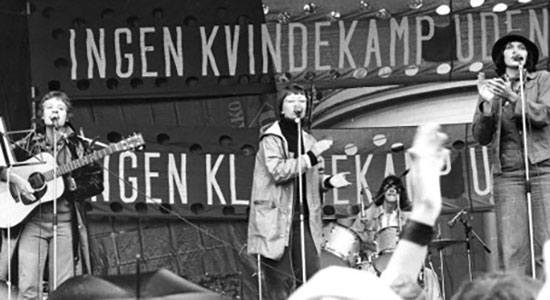
Drawing on archival studies, ethnographic interviews, and fieldwork, and informed by a theoretical framework spanning music anthropology, memory studies, infrastructure studies, and feminist affect theory, the project examines women's role in Danish music life in the 1970s within a broader cultural and gender-historical context. It further situates these perspectives within contemporary feminist debates on how the absence of a collective memory of women’s and gender-minoritised historical contributions repeatedly forces gender equality discussions to begin anew, with implications for how inequalities in music scenes are understood across past and present. Against this backdrop, the project aims to develop ways of foregrounding the works and lives of women musicians active in the 1970s as part of a broader effect to contribute to a more diverse account of music history and musical cultural heritage.
The project is carried out in collaboration with KØN – Gender Museum Denmark and Rockmuseet (The Danish Rock Museum). Alongside research, the project also includes a range of other activities, including the development of educational materials, public engagement formats, and events.
This work package examines musical activities in and around the Danish Red Stocking Movement, in which music played a central role. It focuses, among other things, on women's bands, songwriting and recordings, as well as selected events such as women's festivals and the Femø Women’s Camp (Femø Kvindelejr). Particular attention is given to how music activities functioned as a framework for organizing communities and solidarity, and to how musical groups positioned themselves in relation to the movement's gender-political ideas. The work package further examines how music was used both as a form of activism within the Red Stocking Movement itself, and how the movement's political agendas shaped women musicians more broadly during the period.
This work package examines the archival activism that emerged in the wake of the women's liberation movement of the 1970s, focusing on the collection, preservation and archiving of music created and performed by women. Particular attention is given to the association Women in Music (Kvinder i Musik, KIM), established in 1980 to strengthen women's participation in musical life, which has built up an extensive archive documenting women's musical activity across genres and historical periods. The work package situates KIM within a broader European tradition of feminist archival activism, while also examining the tensions that arise as the archive moves between private and institutional settings. It further explores the archive's affective dimensions, asking how hope, care, and persistence become embedded in archival practices, shaping both their political potential and their enduring today.
This work package builds on the previous ones by translating research insights into collaborative and public-facing activities in partnership with the Danish Rock Museum (Rockmuseet) and KØN – Gender Museum Denmark. It explores how historical knowledge of the contributions of women and gender-minoritised people to music life can be activated within contemporary institutional contexts, and how cultural memory is created, negotiated, and transformed through such engagements. As part of this work, the project facilitates intergenerational conversations between women and gender-minoritised musicians, drawing on selected archival materials to activate the affective dimensions of historical memory in present-day music life. The work package also examines the intransitive dimensions of these collaborations, reflecting on how the encounter between research and cultural institutions shapes both knowledge production and institutional practice.
Researchers
| Name | Title | Phone | |
|---|---|---|---|
| Ligaard, Elise | PhD Fellow | ||
| Ringsager, Kristine | Associate Professor | ||
| Wallevik, Katrine | Postdoc | +4535324681 |
Funding
Project period: 2025-2028
PI: Kristine Ringsager