
Sounding & Listening to Unnoticed Borders
A listening walk to sense-think and share experiences about the established border and liminal space surrounding the Kulturljudzon.
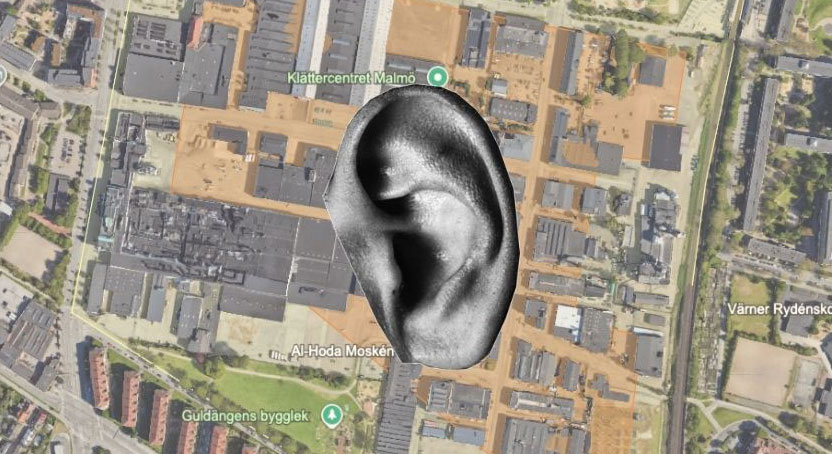
This workshop is part of the Sonic Citizen annual event that brings together academics, artists, activists and policymakers to analyse and celebrate the people and the work that make Malmö’s Cultural Sound Zone. The Kulturljud Zon or Cultural Noise Zone, is described as a granted project until the year 2040 within the urban development proposal of the Sofielund neighborhood in Malmö. This area is meant to work as a territorial container that will freeze housing to comply with the idea of protecting households from noise and disturbances in the area.
The zone has been defined by the project stakeholders and works as a sort of geographical border that is not entirely walkable. In other words, you cannot have access to some of the borders, as these are enclosed spaces surrounded by fences and barbed wire around the yards of large factories or power stations. Thinking about sonic citizenship, we intend to use the border of the delimited zone as a metaphorical territory. Drawing on the Brazilian geographer Milton Santos, the workshop approaches the Kulturljudzon not as a fixed geographical area but as a used territory (território usado), continuously produced through regulations, infrastructures, everyday practices, and relations of power.
From this perspective, the border of the Cultural Noise Zone is more than a planning boundary: it acts as an active territorial device that differentiates what forms of presence, activity, and sound are considered legitimate, desirable, or disruptive. By feeling-thinking (sentipensamiento) while listening, walking, and sharing experiences, we intend to integrate emotion and reason by exploring an "embodied experience" (experiencia acuerpada) as proposed by Tseltal-Maya philosopher Xuno López Intzin.
Is there a sonic differentiation in the liminal space of the Cultural Noise Zone? Who are the human and non-human noises that can be listened to on the border? Do they differ from the center or noise points in the zone? Can we listen to how power, planning, regulation, and belonging are inscribed in the territory through sound?
The workshop will unfold in three stages: a short introduction, a listening walk that invites participants to sense and think with their bodies, and a final critical reflection. After the listening walk, participants will be encouraged to express and externalise their experiences through drawings, gestures, written reflections, or brief audio testimonies. The session will conclude with a discussion of territorial metaphors, sonic regulations, and their relationship to social interactions.
The workshop is open to anyone, and no special skills are required.
Facilitators:
- Laura Balboa
- Lílian Campesato
If you wish to participate, please register here.