
Norwegian Wood: Extractive landscapes, art and visual culture in Denmark and Norway 1730-1860
Norwegian Wood investigates the intersection of art, resource extraction, and forestry in Denmark and Norway from 1730 to 1860, and will be the first to explore how this was reflected in the countries’ art and visual culture.
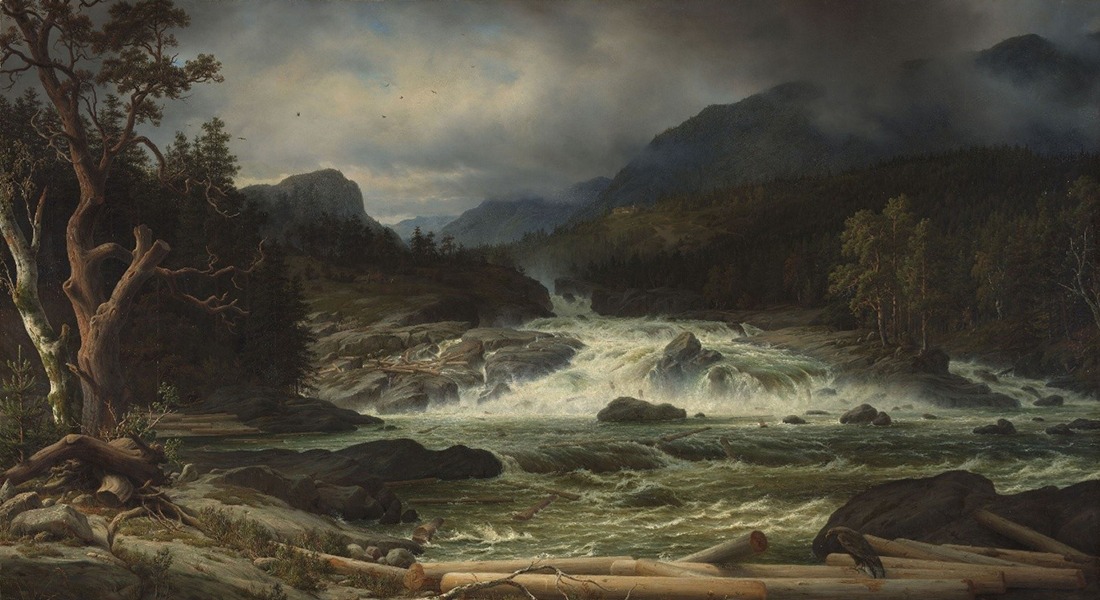
Forests and trees are recurring topics in both Danish and Norwegian Romantic paintings, with works like P.C. Skovgaard’s Parti fra Iselingen Skov (1861) or Thomas Fearnley’s Labrofossen ved Kongsberg (1837) often being read as symbols of national identity and romantic sentiment. Yet a closer look at the number of debarked and uniformly cut logs throughout Fearnley’s Labrofossen raises questions. What are these man-made logs doing in a painting that is usually described as wild nature? The art-historical research project Norwegian Wood approaches the logs as indicative of an overlooked aspect of Danish and Norwegian forest paintings: the connection to lumber extraction. By examining various media, the project will be the first scholarly inquiry into the intersection of art, resource extraction, and forestry in Denmark and Norway from 1730 to 1860 and offer new ecocritical interpretations of art and visual culture in this period.
Starting from the premise that depictions of forests are not neutral ‘representations’ but dynamic historical agents whose functions and contexts change across time and space, Norwegian Wood reevaluates the function and meaning of forest imagery through a selection of in-depth case studies. Besides revisiting celebrated landscape paintings by artists such as Fearnley and Skovgaard, Norwegian Wood seeks to recontextualise the romantic landscape tradition by connecting it to forest depictions in 18th-century Danish-Norwegian art and visual culture. This includes analyses of the visual documentation of the royal travels to Norway throughout the 18th century, the flourishing prospect tradition in the century, as exemplified by J. Rach & H.H. Eegeberg’s views of Copenhagen (1747-1750), the Norwegian prospect prints initiated by Erik Pauelsen (1788-89) and completed by C.A. Lorentzen and Georg Haas (1792-96), as well as the visual material produced by the 18th century General Forestry Commission regarding the storage and shipping facilities at Bremerholmen in Copenhagen. In doing so, Norwegian Wood will examine and critique the connection between eighteenth-century landscape depictions and nineteenth-century landscape painting, revealing how celebrated romantic landscapes of the nineteenth century possess a hitherto unexplored connection to the modern extraction of natural resources.
Norwegian Wood has three main research aims:
-
Representing Materials: Shifting the theoretical and methodological orientation in research on landscape depictions in historical Norwegian and Danish art by considering how forests have been depicted as environments and extractive landscapes. By shifting the focus from seeing representations of forests to looking for lumber, the project will examine how landscape paintings engage with questions regarding rights of ownership, access and management to nature while also considering how visual material has been employed to allow the viewer to identify the land or some of its components as a resource available to be removed, optimise and/or monetised.
-
Circulating Materials: Analysing the infrastructure and imprint of lumber extraction on the Danish and Norwegian art field. By exploring and re-visiting works by artists who either came from or were in close contact with lumber families, Norwegian Wood re-evaluates the suggested subjects of romantic forest paintings by viewing them as commissions from and subjective representations of the lumber industry. The same works will also be examined as vital indicators of the expanse of lumber extraction. This is important as lumber extraction can be less immediately visible than, for instance, mining and therefore easy to overlook. Working with the concept of ‘Reciprocal landscape’ (Hutton 2020) and employing empirical material such as maps, city prospects, and paintings, Norwegian Wood seeks to highlight the networks and impacts that lumber extraction has had on both images and imaginations of rural and urban landscapes.
-
Debating Materials: Creating new platforms to discuss the life and afterlife of the visual and material culture of Denmark-Norway and why it is important to reassess this period when exploring new, interconnected art historical narratives for Danish and Norwegian art. In this capacity, the project will organise a series of seminars and workshops devoted to its main research questions, but also expanding upon these through discourse and collaboration with an interdisciplinary group of researchers and artists.
- Mathias Danbolt (University of Copenhagen)
- Stephanie O’Rourke (St. Andrews)
- Patricia Berman (Wellesley)
- MaryClaire Pappas (Savannah School of Art and Design)
Researchers
| Name | Title | Phone | |
|---|---|---|---|
| Sørensen, Tonje Haugland | Assistant Professor | +4535322381 |
Affiliated researchers
| Name | Title | Phone | |
|---|---|---|---|
| Danbolt, Mathias | Professor, UCPH | ||
| Hallgrän, Anna Maria | Senior lecturer, UMEÅ | +46907866465 | |
| Bjordal, Sine H. | Postdoc, UIO | ||
| Jørgensen, Anna Vestegaard | Project researcher, SMK | ||
| Skovmøller, Amalie | Associate Professor, UCPH | +4535325749 | |
| Thorsen, Line Marie Blok | Postdoc, UCPH | +4535329738 |
Funding

The project is funded by the Novo Nordisk Foundation’s Investigator Grant.
Project period: September 2025 - August 2029
Principal investigator: Tonje Haugland Sørensen