
Metamorphosis – Transformations – Fragrance
Lab seminar series Spring – Autumn 2026
Launch of Metamorphosis in Nature and the Arts: Ecstases of Matter and Image
1 October 2026 14:00-16:00, South Campus, room 4A.1.13
Book launch with editor of the book Nicoletta Isar.
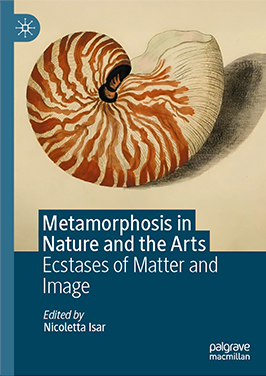 This book explores the concept of metamorphosis across art history, image theory, literary studies, and philosophy. By examining the shifting meanings of metamorphosis in nature, the arts, and technology, this book reveals the traces and ecstases of matter and body in transformation. It asks how images associated with elemental states – terrestrial, aquatic, and ethereal – have commingled throughout history, creating poetic fields of morphic resonance.
The chapters cover a wide range of topics, including the wonders of nature, the occult dimension of nature's artistry, and the vitalizing power of metamorphosis as a principle of life and art. The authors critically engage with philosophical concepts such as genesis, movement, hybridity, and trans-corporeality to reveal unexpected dimensions of metamorphosis, explore the miracles of transmutation of matter in ancient thought, and use new theoretical tools to examine modern ideas of evolution and the metaphysics of mixture addressed within the aesthetics of wonderment.
From the Darkness in Dance
12 May 2026 14.00-16.00, South Campus, room 25.0.40 and online – Session chaired by Emily Kivistö.
Frauke’s Shining Light Trilogy
In post-World War II Japan, the art scene witnessed the emergence of an avant-garde dance, butoh (or butō), meaning “dance-step.” It was developed through the collaboration of Kazuo Ohno (1906-2010) and Tatsumi Hijikata (1928-1986), and was initially known as ankoku butoh, the “dance of utter darkness”. Its origins can be traced to early 20th-century German Expressionist dance, as well as traditional Japanese performance genres such as Noh and Kabuki, although diverging from established theatrical forms within the performing arts.
A central theme in butoh is death as a poeticised aesthetic – a force that gives rise to new visual languages and the concept of the living within death. Kazuo Ohno believed that the veil between the living and the dead is thin, encouraging states of consciousness to dance within this liminal space. It is within this space that the butoh-ka (butoh dancer) begins to excavate the most unsettling human emotions.
This study aims to discern how butoh initiates movement through a process of welling up the unconscious, pivoting on butoh’s use of cathartic philosophy aligned with shamanism. Following Sondra Fraleigh’s rendition, in Butoh - Metamorphic Dance and Global Alchemy (2010):
In butoh, as in alchemy, the darkness of material needs to be undergone before transformation and integration can occur.
In the Noh and butoh performance trilogy Shining Light (2021–2024) by Frauke, a Kyoto-based Swedish Noh and butoh practitioner, conveys a shamanistic sense of revival. She explores the unwavering energies that nature attracts and encapsulates in the performances Amber, Pearl, and Coral, each tied to the elemental, the hidden organic realms, through metamorphoses.
On these grounds, this present research positions Fraleigh’s phenomenological interpretation of butoh in dialogue with Frauke’s esoteric performances in Shining Light, offering insight into embodied metamorphosis and opening a nexus to the spiritual dimensions of contemporary performance art.
Keywords: Shamanism in butoh and Noh, Esoteric dance, Phenomenology, Embodied metamorphosis
Bibliography
Charlene Spretnak, The Spiritual Dynamic in Modern Art: Art History Reconsidered, 1800 to the Present, Palgrave Macmillan, 2014.
Sondra Fraleigh, “Butoh Alchemy,” Butoh Metamorphic Dance and Global Alchemy, University of Illinois Press, 2010, pp. 11-35