
Warm War
Charles Stankievech
Related terms: Coast, Disaster Risk, Environmental Data, Sacrifice Zone, Scenarios, Solar Geoengineering.
The Warm War – our current epoch of conflict increasingly shaped by the cascading effects of climate change and its weaponisation – has already begun. First introduced as a concept by the author in the 2000s (and now used in such broad discourse as official European Commission policy), the Warm War originally addressed the Arctic region’s developing conflicts due to issues of sovereignty, resource extraction and emerging shipping routes through the Northwest Passage due to the rapid melting of sea ice (Stankievech 2009; Vella 2017). The Warm War has since evolved to include a deeper understanding of the intertwined history of weather modelling, climate analysis, and the military-industrial complex. As climate change is a global phenomenon with local effects, the Warm War’s region of concern expanded to encompass the entire planet rather than the Arctic alone (cf. Adger et al./IPCC 2014, 773, 778). Like its predecessor term, the Cold War, the Warm War is as much about ideological battles, economic strategies, and proxy pressure as it is about direct armed conflict. From a historical perspective, much like WW2 can be seen as a continuation of unresolved issues in WW1, the Warm War has overlaps and extends the issues first manifested during the Cold War.
Additionally analogous: as nuclear science was to the Cold War, so is geo-engineering to the Warm War – an applied technological solution with controversial chain reactions that can easily spin out of control due to its complex and global effects. As early as 1955, lead scientist in the Manhattan Project and advisor to the U.S. President on the Atomic Energy Commission, John von Neumann ([1955] 1995, 658-73) wrote that one of the key challenges of the future was “climate control.” His analysis of the issue – as developed in light of game theory in a nuclear-armed world – shared key insights still unresolved to this day. Finally, as the world continues to shift to a multipolar theatre of war, the Warm War wrestles with the politicisation of scientific research and whether to recognise if climate change is even a reality, thus in turn creating a feedback loop that increases the polarisation of politics.
The following entry briefly outlines: 1) the modern relation between meteorology and warfare, 2) the military establishing climate change as a “threat multiplier,” 3) how the military is trapped in a deep cycle of fossil fuels, and 4) how controlling the climate has shifted from a secret weapon of war to controversial geoengineering proposals.
The relation between war and the weather is as old as memory allows. The oldest written narrative that we have, the Epic of Gilgamesh (written ca. 2100-1800 BCE), tells of weather as a divine weapon, and Sun Tzu, who authored the oldest surviving treatise on warfare, The Art of War, ca. 500 BCE in China, articulates the importance of weather in military success. But it would take until the century of speed – the Nineteenth Century – that a true meteorological discipline would be forged. Surprisingly, it took art critic John Ruskin, who lobbied for the field as a practical science, to imagine what was really necessary for weather prediction. In an 1839 paper, he imagined that if meteorology was to function, it must exist as if it was “a vast machine [that] desires to have at its command, at stated periods, perfect systems of methodical and simultaneous observations; it wishes its influence and its power to be omnipotent over the globe, so that it may be able to know, at any given instant, the state of the atmosphere at every point on its surface” (Ruskin 1839, 56-59). Such a dream would become a reality a century later, but not solely due to the cooperative scientific drive Ruskin beckoned (though the U.S. meteorologists James Espy and Joseph Henry did immediately implement a systematic collection of meteorological data via the novel telegraph as a collaborative venture between the Navy and the newly minted Smithsonian) (Smithsonian 1848, 25). Ultimately, the resources required for creating such a “vast machine” were driven by the military’s need for remote sensing and real-time processing with the birth of cybernetics.
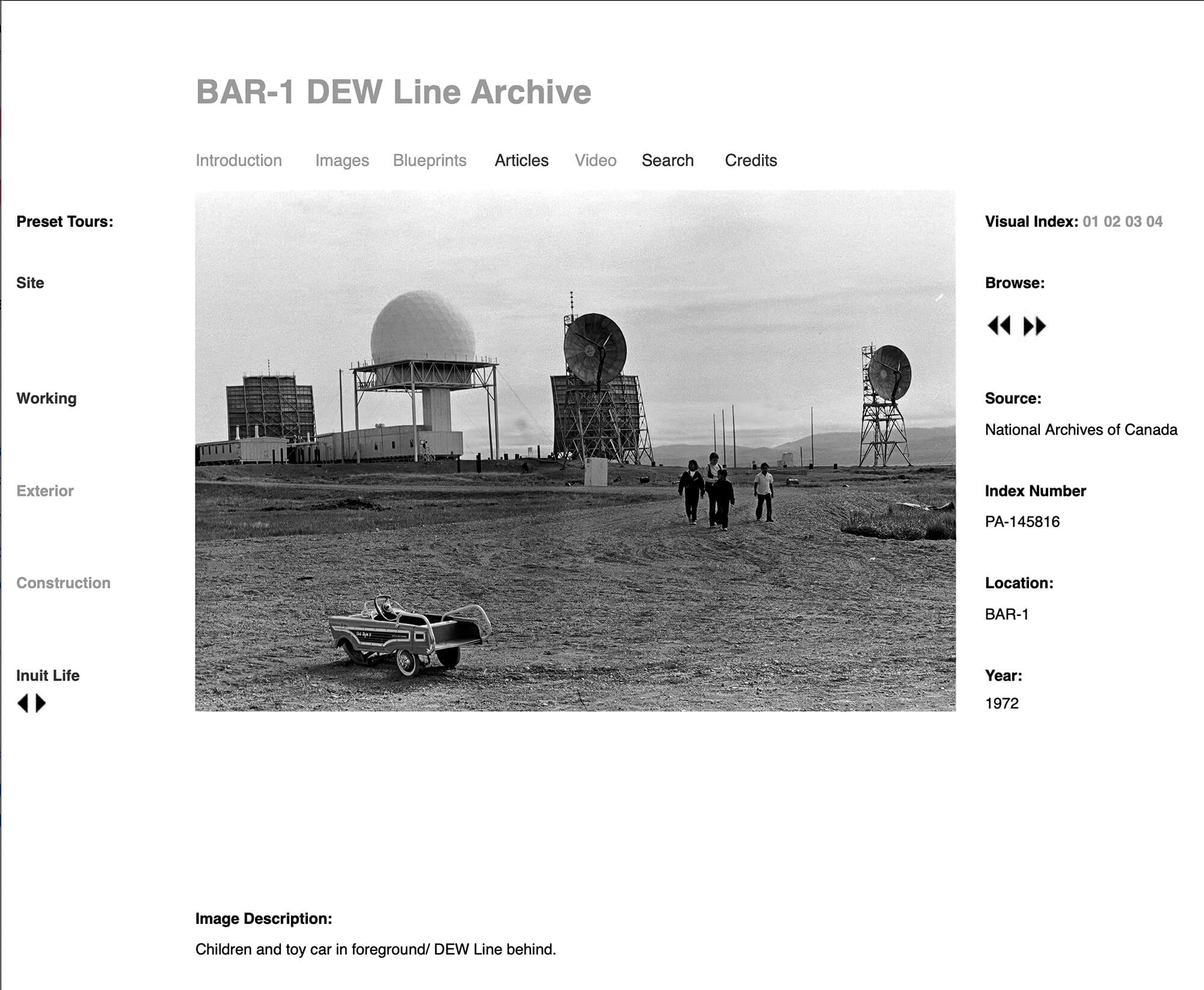
In the decades leading up to the mid-twentieth-century birth of cybernetics, a relevant historical trajectory materialised: a progressive decentralisation of communication based on military outpost architecture that supported Early Warning Systems (Stankievech 2015; Wood 2015). Initially conceived by the military for anti-aircraft warfare, the development of electronic digital computing began as a collaboration between American military research agencies and the U.S. Weather Bureau around 1948 (Edwards 1996). It is no coincidence that subsequent Cold War projects borrowed more than temperature adjectives, cloaking military endeavours in the semiotics of weather. MIT’s Whirlwind computer helped inaugurate cybernetic thinking, rapidly scaling into the urgently built SAGE / DEW early-warning system. The DEW (Distant Early Warning) Line was a string of remote radar stations built in the High Arctic between 1954 and 1957 that connected to NORAD (North American Air Defense Command) in order to detect incoming Soviet bombers carrying nuclear warheads. With the DEW infrastructure, we fully transitioned from using our immediate senses to using remote sensors: the bunkers of WW2 turned into the electronic war rooms of the Cold War. Here, the Arctic enters the theatre of war as part of game theory’s calculation of Cold War nuclear politics, but it also becomes the site of future projections: both as a signifier of climate change in melting sea ice and glaciers, as well as the future zone of interest for ice-free trade and resource extraction in a contentious zone where sovereign borders are still fluid. As such, when the Cold War melted into the Warm War, the Arctic became more and more the focal point for early observations of climate change and its cascading effects – both for environmental and security issues.
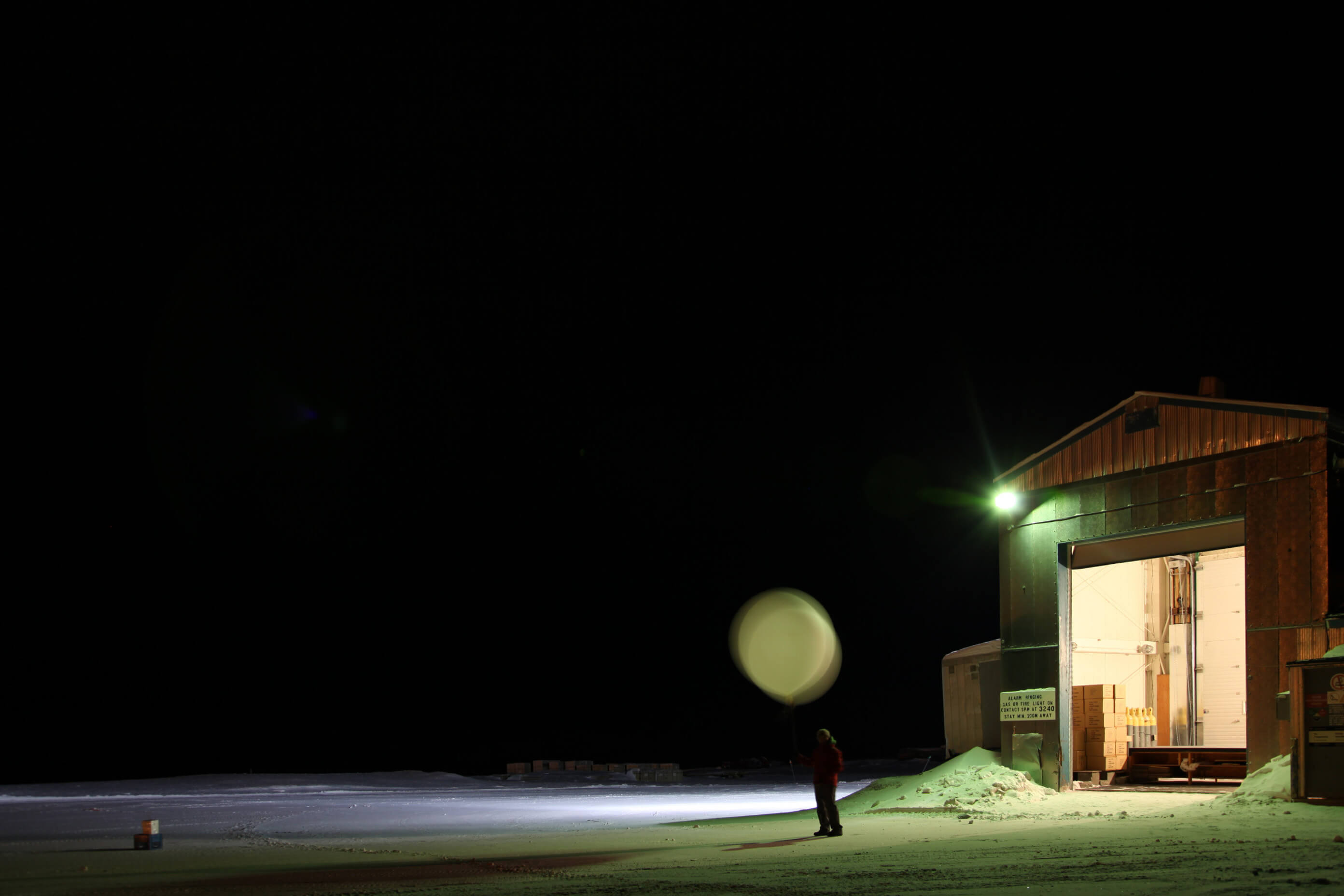
As weather forecasting improved its accuracy and range of projection (both temporally and spatially), the history of weather – what we could call climate change – came into sharper focus. Again, the military’s long-term logistical thinking played an early role, propelled by strategy and security. What began as defensive planning and research funding – including work framed as “pure” science – later hardened into explicit doctrine: climate change as a “threat multiplier” to national security.
The recognition of climate change did not originate within environmental science, which was not yet constituted as a field, but emerged unevenly across institutions attuned to atmospheric and oceanic variability. In the 1950s, the U.S. Navy became an early site of such recognition, as climate effects were encountered not abstractly but as operational limits on maritime power. Backed by several studies funded by the Office of Naval Research, the oceanographer Roger Revelle (1956, 465,474) first foresaw that Arctic warming would reshape geopolitical boundaries by opening previously inaccessible northern routes, altering strategic advantages between Cold War adversaries. As environmental movements in the 1960s began to grow in mainstream culture, academic research and national politics, civilian debates primarily focused on the local effects of pollution, pesticides and biodiversity (Carson 1962). In parallel, classified military intelligence assessments surveyed the literature, searching for as-yet-functional climate models to speculate about global effects related to security (CIA 1974a; 1974b). Less concerned about the science (one report considered the scenario of global cooling), the intelligence reports were outliers at the time, attempting to wrestle with climate change and security.
In the twenty-first century, similar concerns resurfaced – first entering public view through the leak of a Pentagon-commissioned report written by outside consultants – laying out stark projections of climate-driven geopolitical instability (resource conflict, state stress, and forced migration) and urging the U.S. Department of Defense (DoD) to integrate climate risk explicitly into strategic planning (Schwartz 2003). Backed by decades of discussions in the military sphere (albeit behind firewalls), climate change became explicitly and publicly articulated as a security issue in 2007. The CNA Military Advisory Board, comprising retired U.S. generals and admirals, directly categorised climate change as a “threat multiplier” capable of exacerbating global instability (2007). Other notable activities in 2007 include key policy reports from the UK and Germany, as well as a UN Security Council debate on climate-related security risks (chaired by the UK) (DCDC 2007; WBGU 2007; UN 2007). 2008 and 2009 saw China and Russia join the discourse, but only with minimal, performative rhetoric. By 2010, the DoD officially entrenched strategic defence planning regarding climate change as both an operational and infrastructural threat - thereby formalising decades of preceding military research into actionable policy frameworks (DoD 2010).
Despite the military’s “early warning” of climate threats, high-level defence politics have consistently sought exemptions from climate accountability. This stance became clear during the drafting of the 1997 Kyoto Protocol, when the DoD successfully lobbied for exemptions from greenhouse gas emission restrictions (Berenson 1997). Such lobbying underscores that observing climate change as transpiring is far from committing to correction. While civilian politics debated the reality of anthropogenic climate change, the military largely accepted it – yet resisted emissions cuts unless they produced direct operational gains, such as efficiency improvements that extend airpower range. Instead, the military-industrial complex helps perpetuate a “deep cycle” of economic expansion, fossil-fuel dependency, and climate harm (Crawford 2019). Not surprisingly, by pulling together various reporting methods and deductions due to a lack of continuous transparency, one can track how the U.S. Department of Defense remains the world’s largest institutional consumer of petroleum globally, directly responsible for the federal government’s largest emissions of greenhouse gases, both historically and currently. Like a snake biting its own tail: the military, needing oil to operate, must secure and protect oil supplies, which in turn need oil to operate abroad… As U.S. General David Petraeus famously said in the year he became the director of the CIA, “Energy is the lifeblood of our warfighting capabilities” (DoE 2011).
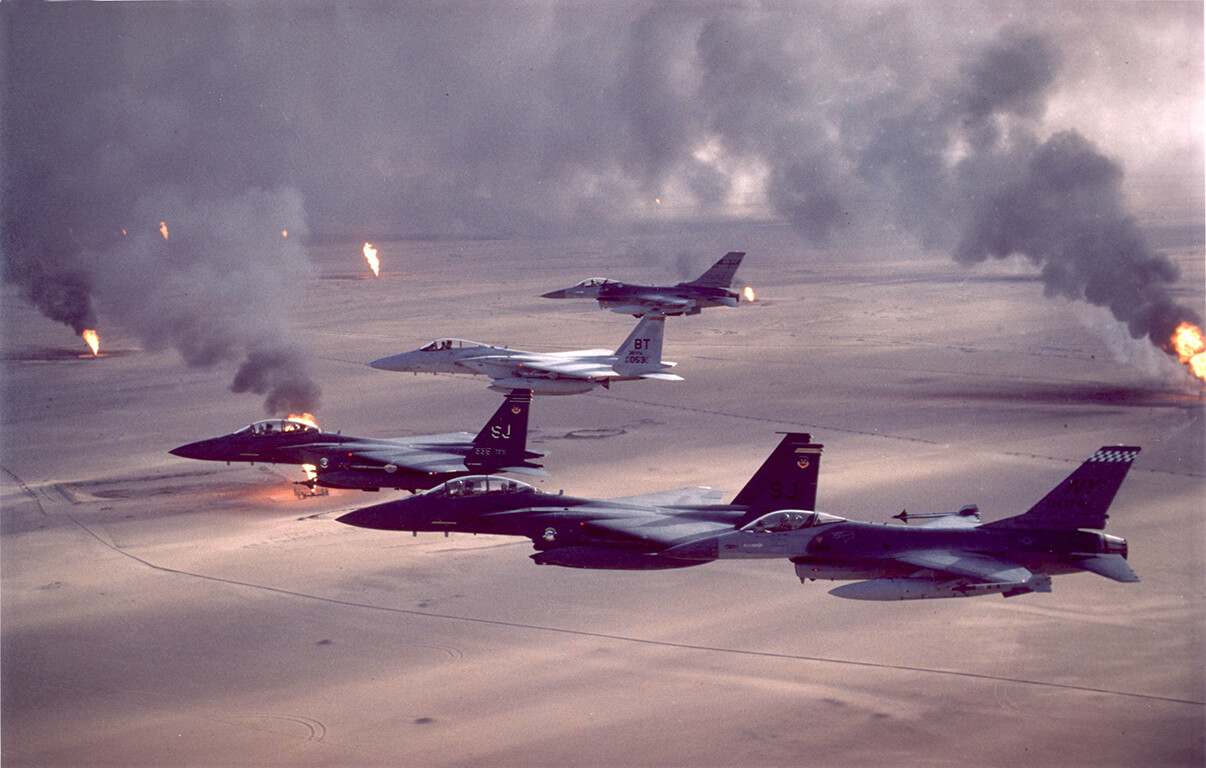
The burning forests in WW1 were typically considered collateral damage to artillery warfare, but the “Great War” also marked a significant change in military strategy: the weaponisation of the atmosphere. In Bunker Archeology, Paul Virilio described the pivotal moment in WW1, with the introduction of gas warfare, that “total war” was waged and “competed successfully with natural forces” by assaulting not the enemy directly but their environment. A new landscape was thus forged where “firearms, explosives, smoke screens, and gases have contributed to the creation of an artificial climate” (Virilio 1975, 37) Immediately following World War II, Allied experiments to de-ice aircraft helped spur the development of cloud seeding – the artificial inducement of precipitation in targeted areas – which was later weaponised in a U.S. program run from 1967 to 1972 during the Vietnam War. Once the classified “Operation Popeye was leaked in the Pentagon Papers, the weaponisation of weather (along with other environmentally destructive strategies used in the Vietnam War) was eventually banned in the 1977 ENMOD treaty – formally known as “Convention on the Prohibition of Military or Any Other Hostile Use of Environmental Modification Techniques” (UN 1976, 36-38). But as with the morphology of clouds, where boundaries between types are often indistinct, determining what constitutes environmental modification is a nebulous task and difficult to trace. Furthermore, such an ambiguous space also creates a fog where conspiracy narratives flourish.
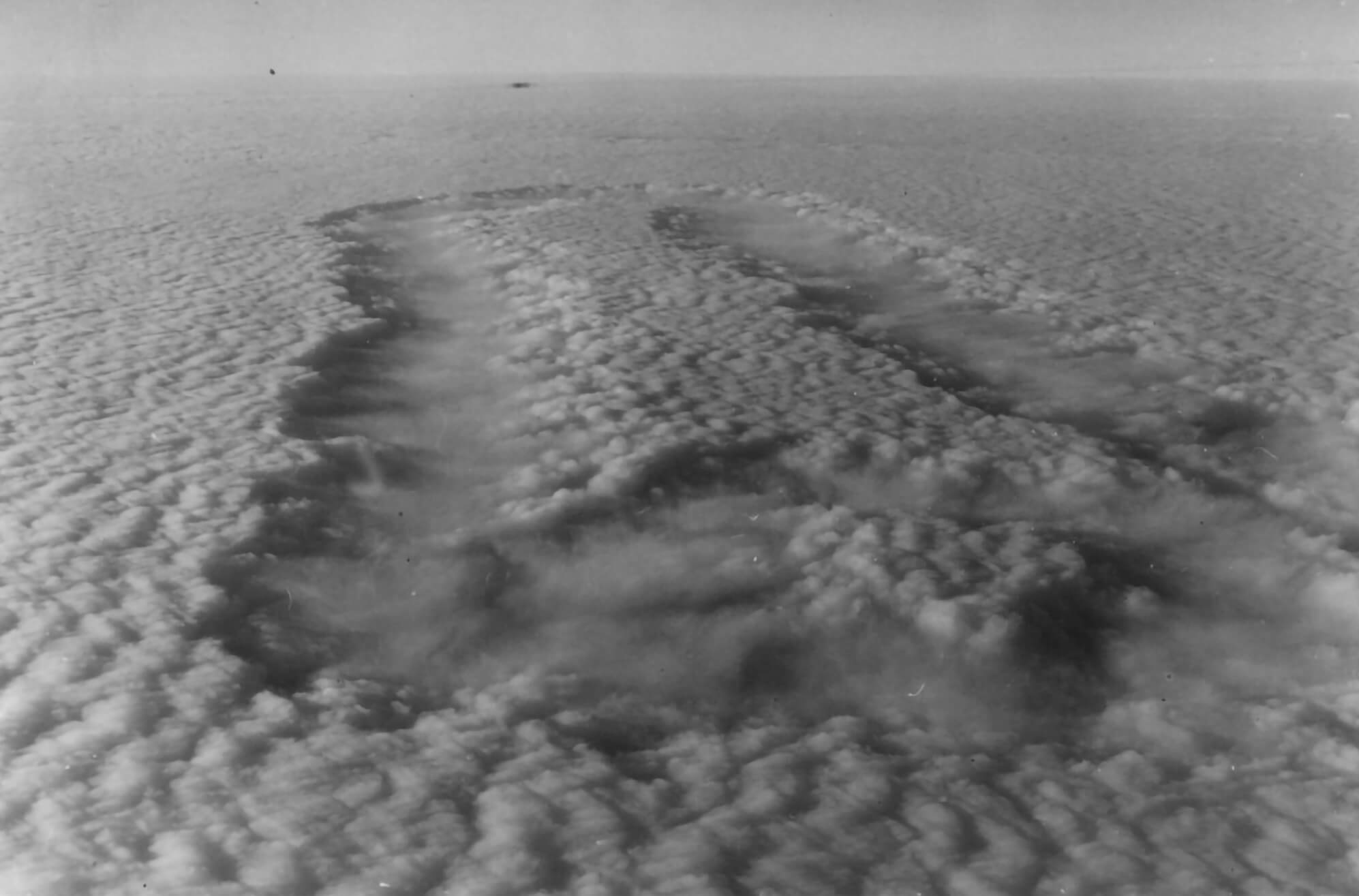
One could argue that ENMOD laid the foundations for the current civilian international agreements that eventually and explicitly prohibited geo-engineering, such as the ones formalised at COP10 (2010). While weather modelling was historically an observational practice, the computational turn in meteorology, driven by military imperatives, marked a shift from understanding the atmosphere to actively intervening in it. We not only create models to measure the world; we create models to modify the world. This trajectory has only intensified as computational modelling has exponentially grown and as we now confront an immediate environmental crisis. The call to urgently repair and reengineer the atmosphere intensifies. As a result, climate control has shifted from a secret weapons program and agricultural optimisation as dreamt of in the Cold War to an option of last resort in the Warm War for a consumeristic world gluttonously unable to curb its emissions. Whether such an action results in direct destruction of the neighbour’s territory or acts as a “threat multiplier” that destabilises the neighbour’s political state or is misinterpreted as an act of aggression itself that triggers a military response becomes moot. The Warm War is deferential when tracing accountability.
As the rule of law and international alliances erode, already fragile and contested regions like the Arctic come under increasing strain. Newly decolonising territories such as Greenland and long-standing settler colonies such as Canada find themselves pressured from all sides in the Warm War – forced to fend off advances not only from historic adversaries but from recent allies, not only from geopolitical rivals but from the accelerating realities of climate change itself. Where Mutually Assured Destruction once stabilised the Cold War by making nuclear winter unthinkable, the Warm War unfolds through an inverse logic: one in which proposed solutions appear mutually exclusive rather than mutually restraining. The long-elusive Northwest Passage today has been charted with multiple routes. Yet, even after Michel Serres ([1992] 1998, 103) wrote of its labyrinth forty years ago – after four centuries of frustrated attempts – the passage still resists decisive movement and safe passage, both literally and metaphorically. And as the nineteenth-century war theorist Carl von Clausewitz warned: “Lastly, the great uncertainty of all data in War is a peculiar difficulty, because all action must, to a certain extent, be planned in a mere twilight, which in addition not unfrequently – like the effect of a fog or moonshine – gives to things exaggerated dimensions and an unnatural appearance.”
References
Adger, W. N., et al./IPCC. 2014. “Human Security.” In Climate Change 2014: Impacts, Adaptation, and Vulnerability. Part A: Global and Sectoral Aspects, Contribution of Working Group II to the Fifth Assessment Report of the Intergovernmental Panel on Climate Change. Edited by C. B. Field et al. Cambridge: Cambridge University Press.
Berenson, Douglas. 1997. “Pentagon Officials Consider Asking for Waiver for U.S. Forces: DOD Officials Warn Climate Change Treaty Could Harm Military Readiness.” Inside the Pentagon 13 (41) (October 9): 10-13.
Carson, Rachel. 1962. Silent Spring. New York: Fawcett Publications.
Central Intelligence Agency (CIA). USA. 1974a. Potential Implications of Trends in World Population, Food Production, and Climate. Directorate of Intelligence, Office of Political Research. Washington, DC: U.S. Government Printing Office.
Central Intelligence Agency (CIA). USA. 1974b. A Study of Climatological Research as It Pertains to Intelligence Problems. Washington, DC: U.S. Government Printing Office.
von Clausewitz, Carl. (1832/1873) 2006. On War. Translated by Colonel J. J. Graham. Project Gutenberg. https://www.gutenberg.org/files/1946/1946-h/1946-h.htm.
Conference of the Parties to the Convention on Biological Diversity (COP10). 2010. “Decision X/33: Biodiversity and Climate Change” Montréal: Secretariat of the Convention on Biological Diversity.
Crawford, Neta C. 2019. “Pentagon Fuel Use, Climate Change, and the Costs of War” Providence, RI: Watson Institute for International and Public Affairs, Brown University.
Department of Defense (DoD). USA. 2010. Quadrennial Defense Review Report.
Department of Energy (DOE). USA. 2011. Energy for the Warfighter: The Department of Defense Operational Energy Strategy. June 14.
Development, Concepts and Doctrine Centre (DCDC). 2007. The DCDC Global Strategic Trends Programme 2007-2036. UK Ministry of Defence.
Edwards, Paul N. 1996. The Closed World: Computers and the Politics of Disclosure in Cold War America. Cambridge, MA: MIT Press.
Military Advisory Board (MAB). 2007. National Security and Climate Change. Arlington, VA: CNA Corporation.
von Neumann, John. (1955) 1995. “Can We Survive Technology?” In The Neumann Compendium, edited by John von Neumann, F. Bródy, Tibor Vámos. Singapore: World Scientific. Originally published in 1955.
Revelle, Roger. 1956. “International Discussions of IGY [International Geophysical Year].” In Second Supplemental Appropriation Bill, 1956: Hearings Before Subcommittees of the Committee on Appropriations, House of Representatives, Eighty-Fourth Congress, Second Session. Washington, DC: U.S. Government Printing Office.
Ruskin, John. 1839. “Remarks on the Present State of Meteorological Science.” Transactions 1: 56–59. Meteorological Society of London.
Schwartz, Peter, and Doug Randall. 2003. “An Abrupt Climate Change Scenario and Its Implications for United States National Security” Pasadena, CA: California Institute of Technology; NASA Jet Propulsion Laboratory.
Smithsonian Institution. 1848. First Report of the Board of Regents of the Smithsonian Institution. Vol. 1. Washington: Smithsonian Institution.
Stankievech, Charles. 2009. “Cinema, Gramophone, Radio: A Quiet History” eContact! 11 (2) (July).
Stankievech, Charles. 2015. The Centre Cannot Hold. Berlin: K. Verlag.
United Nations. General Assembly. 1976. “Convention on the Prohibition of Military or Any Other Hostile Use of Environmental Modification Techniques.” Resolution 31/72. In Thirty-First Session: Resolutions and Decisions, 21 September–22 December, A/31/39. New York: United Nations.
United Nations. Security Council. 2007. “Security Council Holds First-Ever Debate on Impact of Climate Change on Peace, Security, Hearing over 50 Speakers”, Press release, April 17.
Vella, Karmenu. 2017. “High-Level Session of the Arctic Stakeholder Forum: European Investment Priorities for the Arctic” Speech (with transcript), European Commission, June 16, 2017.
Virilio, Paul. (1975) 1994. Bunker Archeology. Translated by George Collins. New York: Princeton Architectural Press.
Wissenschaftlicher Beirat der Bundesregierung Globale Umweltveränderungen (WBGU) [German Advisory Council on Global Change]. 2007. Climate Change as a Security Risk. London: Earthscan.
Wood, David Murakami. 2015. “The Listening Ear: British Coastal Wireless Interception Stations and After.” In Charles Stankievech, The Centre Cannot Hold. Berlin: K. Verlag.