
Traps
Paolo Patelli
Related terms: affordance in environmental history, companion species, environmental data, more-than-human, multispecies sensing, sympoiesis
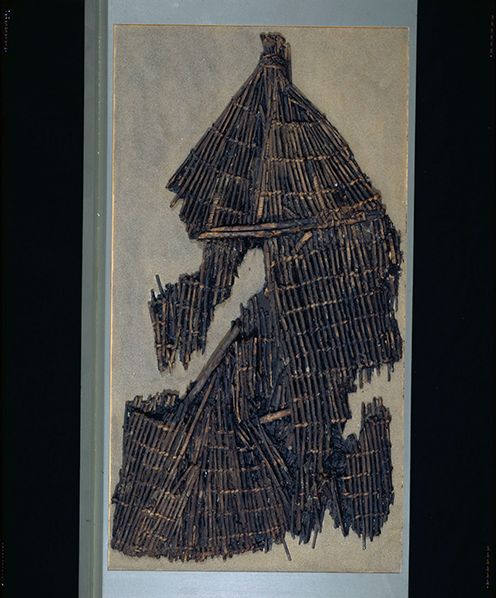
At the Nationalmuseet in Copenhagen – Denmark’s largest cultural history museum, at once a repository of material culture and a space for storytelling – visitors pass the skeletons of now-extinct aurochs, driven to extinction in the 17th century by a long process of deforestation for agriculture and hunting, and the small, portable magical amber figures of five bears, a bird, and an elk, before arriving at two osier creels from the Mesolithic (Fig. 1). These woven forms, within the museum’s collection, almost inevitably evoke Ursula K. Le Guin’s “Carrier Bag Theory of Fiction” (1986). Drawing on anthropologist Elizabeth Fisher, who argued in Women’s Creation (1975) that the first human tool was not the hunter’s spear but the humble container, Le Guin broadens what counts as technology in relation to narrative. She shifts attention away from what she calls “the linear, progressive, Time’s-(killing)-arrow mode of the Techno-Heroic” and instead champions stories that serve as a “carrier bag”: something that gathers and holds, keeping things in relation. The creels on display both illustrate and complicate this distinction.
Used by small groups of hunter-gatherers as fish traps, probably incorporated into heavy timber weirs, they are at once containers and instruments of capture. They hold things together by enacting both care and lethal agency, providing sustenance and enforcing domination, and enabling survival and extinction. If Le Guin’s carrier bag turns plot from a line into a gathering, the creels turn predation from a chase into an entanglement, in which prey, predator, and environment become co-caught in a mesh rather than aligned along a single temporal or agential line. Traps refigure predator–prey relations not as a sequence but as a patterned ecological co-implication, a mutual and dynamic interdependence, such that neither element can be fully understood or actualised in isolation from the other and their environment.
Following Alfred Gell (1996), a trap models both its maker and its victim by objectifying the predator’s intentions and the prey’s dispositions within a single apparatus, inscribing skill and behaviour at once. As a surrogate device, it embodies the design of a maker who has withdrawn and the habits of a victim who will eventually draw near, staging a scenario and a time-structure in which predation unfolds as dramaturgy – again, a plot – rather than a one-way chase. Traps are spatial devices that exploit and weaponise perceptual attunement, the shared sensitivities and cues through which predators and prey learn to navigate one another’s worlds, calibrating to the other’s habits, senses, and routines. When scaled up from object to system, traps condition behaviours not only at the moment of capture but continuously, making mutual orientation and deception a structuring condition of environmental life. They act as ambivalent infrastructures that mediate both protection and harm, and through which coexistence is negotiated.
These dynamics are not limited to human designs. In a different museum, perhaps one dedicated to natural history, one might move beyond anthropocentric understandings of traps as merely human tools and attend instead to their nonhuman inspirations. The construction of creels, net or cage traps may well have been prompted by a humble web-spinning spider; its relative, the trapdoor spider, could have provided a blueprint for the pitfall trap – still commonly used in ecological research and pest control to catch ground-dwelling invertebrates – while insectivorous plants such as butterworts and pitcher plants readily suggest the use of a lure (Bateman 1972).
From this perspective, traps appear as diagrams of relationality and ecological exchange: not exactly images or representations of reality, but tools that bring relations into operation (Fig. 2 below). They render intricate ecological relations material, for example, as interplays of gravity, surface texture, light, and locomotion, and yet what is operative and material is not necessarily visible. Traps work precisely by staging asymmetrical relations while receding into the background. Capture is produced not through overt violence but through projection, attraction, and misrecognition: the designer is absent, and the environment itself seems to “do the work.” It is this displacement of agency that gives traps their force as ethical provocations. Central to this operation is the collapse of figure into ground (or camouflage). The trap, when in function, cannot appear as an object and becomes part of the environment: a creel reads as current; a pitfall reads as ground; a snare reads as path. What should stand out as danger recedes, while what attracts attention – a bait or an opening – emerges as figure. Traps thus rely less on force than on perceptual alignment, capturing bodies when the environment itself seems to invite movement. Responsibility is therefore visually and spatially displaced.
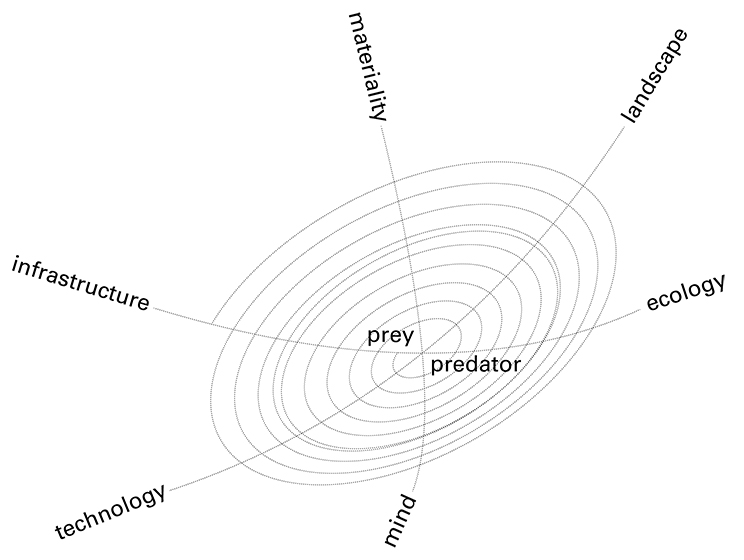
Through their operations, traps blur boundaries between material device and conceptual operator, functioning as “theoretical interfaces” (Corsín Jiménez and Nahum-Claudel 2019). To think with traps is to recognise them as dynamic assemblages in which material forms, distributed agencies, and multispecies relations converge, offering several intertwined dimensions.
One way into this assemblage is through the trap’s materiality. From weirs and snares to nets, fences, lures, and sensor devices, traps are environmental configurations that enable capture and conditioning through spatial arrangements of what can be caught, killed, studied, or preserved. They cut ecological sections into the landscape and, by rerouting flows of bodies and signals, their materiality – following new materialist and actor-network theory approaches – proves not inert but agentive. At different scales, from fixed-gear fishing technologies (Swanson 2019) to landscape-sized traps such as the Dutch eendenkooien (van Heijgen, Driessen and Turnhout 2024) and ponds with catch channels also found on Fanø in Denmark, design choices transform multispecies landscapes.
Moreover, traps constitute fields of distributed agency: Spatial dispositions of thresholds, apertures, and enclosures define how humans and/or nonhumans can interact along a scripted sequence of movements and encounters. Despite evident asymmetries of power, however, agency cannot be limited to the predator’s intention: The trap exceeds the designer’s plans, challenging anthropocentric narratives of control when the prey learns to skirt traps, steal bait without triggering mechanisms, or reroute their movements altogether.
Traps also function as epistemic devices: from camera traps to laboratory setups, they generate data, images, and stories that shape human understandings of nature (O’Neill 2023). As with creels and fishing nets, the aperture of the mesh must be tuned to catch elements of just the right size, selecting what can appear and be known while letting go of the irrelevant (Lahoud 2016).
Finally, traps intersect with political ecologies: If “man-traps” were infamously used by landowners to violently immobilise poachers and capture runaway enslaved people, today border infrastructures act as traps for migrants and non-humans alike (Sundberg 2011), while anti-poaching camera traps expose global circuits of animal trafficking (Jaclin 2016).
Traps embody key concerns of the environmental humanities: distributed agency, multispecies entanglement, and epistemic production. They are minor architectures of the Anthropocene, relational assemblages in which design, ecology, and power condense at a small but consequential scale.
References
Bateman, James A. 1971. Animal Traps and Trapping. Harrisburg, PA: Stackpole Books.
Corsín Jiménez, Alberto, and Chloé Nahum-Claudel. 2019. “The Anthropology of Traps: Concrete Technologies and Theoretical Interfaces.” Journal of Material Culture 24 (4): 383-400.
Fisher, Elizabeth. 1979. Woman’s Creation: Sexual Evolution and the Shaping of Society. New York: Anchor Press/Doubleday.
Gell, Alfred. 1996. “Vogel’s Net: Traps as Artworks and Artworks as Traps.” Journal of Material Culture 1 (1): 15-38.
van Heijgen, Eugenie, Clemens Driessen, and Esther Turnhout. 2024. “The Landscape Is a Trap: Duck Decoys as Multispecies Atmospheres of Deception and Betrayal.” Transactions of the Institute of British Geographers 49 (3).
Jaclin, David. 2016. “Poached Lives, Traded Forms: Engaging with Animal Trafficking around the Globe.” Social Science Information 55 (3): 400-25.
Lahoud, Adrian. 2016. “Scale as a Problem, Architecture as a Trap.” In Climates: Architecture and the Planetary Imaginary, edited by James Graham, Caitlin Blanchfield, Alissa Anderson, Jordan Carver, and Jacob Moore, 111-19. New York: Columbia Books on Architecture and the City.
Le Guin, Ursula K. 1988. “The Carrier Bag Theory of Fiction.” In Women of Vision: Essays by Women Writing Science Fiction, edited by Denise Du Pont. New York: St. Martin’s Press: 1-12
O’Neill, D. Cuong. 2023. “Ecomedia in the Wild: Camera Traps, Geiger Counters, and Radioactive Boars.” Critical Inquiry 49 (3): 337-58.
Sundberg, Juanita. 2011. “Diabolic Caminos in the Desert and Cat Fights on the Río: A Posthumanist Political Ecology of Boundary Enforcement in the United States–Mexico Borderlands.” Annals of the Association of American Geographers 101 (2): 318-36.
Swanson, Heather Anne. 2019. “The Entrapment of Trap Design: Materiality, Political Economy and the Shifting Worlds of Fixed Gear Fishing Equipment.” Journal of Material Culture 24 (4): 401-20.