
Local
Related terms: authentic, colonialism, exoticism, extraordinary, gaze, orientalism, place, primitive, tourism, traditional.
A Changing Landscape, A Shifting Demography
I grew up in the archipelago of Indonesia, a postcolonial nation and global tourism destination, which, in 2022, garnered Forbes’s recognition as the “Most Beautiful Country” on Earth (Forbes 2022; US News Travel 2024). I believe the Western world often conjures the images of Bali, one that historian and fiction writer Willard A. Hanna (2016) calls “a pacific paradise.” But let me introduce my hometown in Java, located approximately an hour’s flight from that oft-promoted Island.
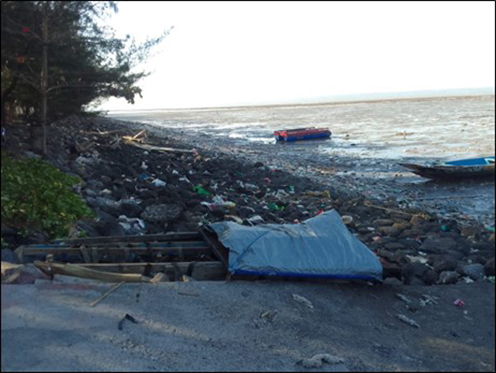
In the vicinity of my neighbourhood, there exists a shore area called watu-watu (Javanese: “the stones”). Hundreds of thousands of stones, roughly the size of car tyres, arrange themselves like a military formation. The shoreline faces toward the northeast, which for years has afforded me the sublime experience of sitting on and enjoying beautiful sunrises. Not far from it are the historic ruins of the Dutch coastal artillery station (kustbatterij), blueprinted in 1900 by De Kapitein der Genie in Batavia (now Jakarta) (Widyaningrum 2020).
Watu-watu was an organic extension of the ‘official’ Kenjeran Beach, established by the government in 1947, two years after the nation gained independence. The beach was still accessible for free at least until I went to high school. The physical and administrative border was reinforced after the government gradually made changes and established restrictions on all entry points (Kusnadi et al. 2024; Kumparan 2024). Before that, I was unsure where the precise boundary lay between the official beach and the watu-watu, between the tourism site and a ‘mere’ neighbourhood. To me, it always existed as a singular, undifferentiated landscape.
Time flew. I did not realise how much of an outsider I had already become. I am no longer part of the beach’s caretaking. I must now pay for a ticket at the entrance. The demography also slowly changed. People who already live and make a living by fishing must switch jobs. Some became unofficial parking operators; others sold coconut drinks. Voluntary and forced displacements also took place, a familiar problem that already occurred in Bali due to tourism gentrification (Suyadnya 2022). In this case, new people with more capital came from different cities to open small businesses and started calling themselves ‘local,’ although they are from completely different ethnic backgrounds. To become part of it, they would be more incentivised economically. So, I get it.
But here is the nuance. In the eyes of the tourists, they are just the same: the polite and nice locals whose culture is authentic.
An Allegory of Otherness
Whenever I heard the Western tourists – or bule (the Whites) – called us ‘local,’ I was suspicious that it was more than just about the place and the residents. Only after entering academia did I come to realise the imperative of analysing the meanings embedded in it. Such analysis is not simply to advance anti-imperialist resistance, though this is politically necessary. Rather, as environmental humanities scholars put it, this analysis must first and foremost pay “attention to the complexity, contradictions, and complicities of the figure of the Global South” projected by the Northerners (Didur et al. 2016, 4). In other words, the analysis is to juxtapose the tourists’ gaze at what they call ‘local’ and my own social and spatial perception.
One of the 500 most common words in contemporary English, the term ‘local’ is defined by the Cambridge Dictionary as “a person who lives in the particular small area that [one is] talking about” (noun) or “from, existing in, serving, or responsible for a small area, especially of a country” (adjective) (Cambridge Dictionary, n.d.). The Oxford English Dictionary dates the etymology back to the Middle French to Anglo-Norman, and to the 2nd-century Latin root, locus, which generally means “relating to place” (Oxford English Dictionary, n.d.). In all these senses, it consistently refers to anything or anyone associated with a specific place.
Any word, however, can acquire nuanced meanings if uttered by a person in power. Walter Benjamin (1986, 314–31) has reminded us that when encountering the Other in a subordinate position, humans tend to “overname” things, like the biblical Adam, who once overnamed the animals. Overnaming, according to Benjamin, is an act that involves exercises of authority, causing the referred figures to become mute. It is due to Benjamin’s influence that postcolonial theorist Gayatri C. Spivak (1972) later scrutinises the “allegoric tendencies” in Western literature. And those who are familiar with Edward Said’s work can agree that exoticism is also part of the allegorical strategy written about the culture of the Orient (Said 2003).
Following this tradition of critique, environmental humanities scholar Elizabeth DeLoughrey contends that allegory serves as a supportive tool for the “human ability to reckon the totality of the planet,” particularly when a human being experiences a felt “rupture” that needs to be reconciled. She contends that “[i]t is precisely at this disjuncture between our awareness of the planet as a totality and our experience of embedded place that allegory plays a vital role … [in other words, at this] rupture between the space of the planet and local place” (DeLoughrey 2019, 11). Put simply, allegory reconciles by absorbing the Other into one’s own totality.
‘Local,’ too, can be considered an allegory. Whether referring to the people (e.g., ‘the locals’) or their related attributes (e.g., ‘local foods,’ ‘local customs,’ etc.), it is the way tourists may attempt to align their planetary worldview with the advent of an extraordinary experience.
Critical tourism scholars have shown that the binaries, such as ‘hosts/guests,’ ‘domestic/international,’ or ‘local/foreign,’ are often racially motivated. On the one hand, it sharpens the cultural distinction between the visiting and the visited people; on the other, it creates a false singularity of those inhabiting the lands, as if people’s racial/ethnic characteristics are pure, static, and far from a mixture (Silver 1993; Franklin and Crang 2001; Buzinde et al. 2006).
As such, ‘local’ does not simply refer to people who live in a certain territory; it instead territorialises them. It is part of “the tourist gaze” (Urry 1990). And the primary reason, as sociologists affirm, is that the tourism industry has long relied on the desire to see and enjoy the sense of Otherness, which makes race a valuable heuristic term to unpack what is actually taking place (Jameson 2016).
Yet, ‘local’ is not just about fetishising the racial Other. It also, and notably, pertains to the spatial and environmental Other, to the space and the climate that is out there, that “I am not familiar with.”
What I mean by ‘environment’ is not just a village crossed by a river and full of fireflies or a mountain covered by a vast green blanket. Neither do I refer to the humanly built one, such as the crossroad filled with skyscrapers -- although it may include all of them. In the classical sense, ‘environment’ is a biological concept explained through a third-person point of view: It is what surrounds the ‘organism’ (Lewontin and Levins 1997). ‘Environment’ is what ‘nature’ is.
But another sense of the term, which I am using here, is the perception of a particular place that shapes or is shaped by one’s behaviour, positionality, or belief about who he/she is as a human. ‘Environment’ is a first-person point of view, as the person is always involved in the entanglement. It might be rightly referred to as an “implosion of the discursive realms of nature and culture” (Haraway and Goodeve 2000, 105), thus, ‘natureculture.’ This discursive realm, which takes place in the mind, body, and the nexus of socio-ecological relations, is what, in turn, disrupts the environment in the first sense.
Nothing exemplifies this better than what New York Times bestseller Matt Kepnes writes to showcase the tourists’ mental state, particularly the pleasure of the sense of environmental Otherness. A decade after his famous publication How to Travel the World on $50 a Day, he writes:
When I think of paradise, my mind drifts to white sand beaches, azure blue water, and palm trees in tropical locales. When most people think of paradise, chances are they’re also thinking of tropical islands in far-flung corners of the world. … Tropical islands are that peaceful escape where the days drift by, the problems of the world melt away, and time slows down (Kepnes 2024).
For tourists like Kepnes, the already-overnamed “paradise” represents the otherworldly life, a territory where the “problems of [their] world melt away.” Tourists are searching for the extraordinary so that they can escape their daily, noisy lives. This need explains why the paradise should be located in a designated territory. If no such territory is available, the capital owners or the state will make it, establishing a binary between the tourist site and what is not, between the extraordinary environment and what is just an everyday place.
A Coloniality of Space
How this perception of space relates to colonial history is even more enthralling. Tourism scholars, from Robert A. Britton to the recent issues of Itinerario journal, have for five decades discussed how tourism site development originated in and perpetuates colonial expectations and myths of the islands near the equator (Britton 1979; Palmer 1994, 19; Echtner and Prasad 2003; Cohen 1995; Caton and Santos 2008; Cantallops and Cardona 2015; Hall and Tucker 2004; Carrigan 2011; Timothy 2019; Zuelow, 2024).
What also cannot be overlooked, however, is how this spatial perception is rooted in the Eurocentric mapping of the globe. Even Carl Schmitt himself, the introspective theorist of European international law, acknowledges that European colonisation was the first instance of “global linear thinking,” namely, when they demarcated the still “free space” of the colonies with lines, either according to their functions or to their borders with other imperial powers. The latter form was first demonstrated by the Spanish and Portuguese-signed Treaty of Tordesillas (1494), which established the “first global line” that cut the entire Earth into two spherical territories. This agreement later served as the basis of the Peace of Westphalia (1648), famously identified as the commencement of the modern state (Schmitt 2006, 86–100). Colonialism, in other words, was a “designation of a space of exception overseas” (Blanco and del Valle 2014, 3).
Not only did this period result in Europe’s auto-instituting as the centre of the global map (Dussel 1995; Maldonado-Torres 2004), but the practice itself initiated the historical development of a broader spatial panopticism in Western politics to this date. ‘A coloniality of space,’ we may call it.
This coloniality of space extended, for instance, to the famous “Jefferson grid,” which is now visibly found across the entire landmass of North America. It is an audacious grid system that was utterly unrecognisable to the Indigenous communities as well as native floras and faunas, yet was overtly expected to comprehend and manage the land (Cheng 2019, 17-36). In his recent book, Liberty’s Grid, Amir Alexander contends that Thomas Jefferson did not make such a decision simply for a practical purpose. As a mathematician, Jefferson was deeply influenced by Cartesian and Newtonian views of space.
[F]or him the Cartesian grid was not the meaningless pattern it appears to us but a scheme redolent with philosophical, political, and moral significance. For Jefferson, following Newton and Locke, gridded space was empty space, and empty space was where men could be free. It was, in other words, precisely what America was in Jefferson’s mind (Alexander 2024, 12).
Another residue of this type of spatial marking is found on Manhattan, which Marxist urban scholar Peter Marcuse accuses of being a result of “laissez-faire planning” in the nineteenth century (Marcuse 1987). This often-filmed landscape features the rigid demarcation between apartment blocks and Central Park, whose establishment was also marked by violence (Miller 2022).
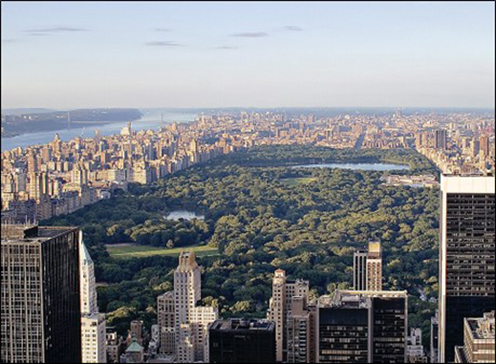
In light of this coloniality of space, critical geographer Denise Fay Brown is right to critique “tourists as colonisers.” Focusing on Quintana Roo, Mexico, she considers the territorial marking in a tourism site a “spatial appropriation,” an old-age strategy for domination in colonial times performed by one group upon others. For her, the tourists’ “presence in exotic landscapes results in the reterritorialization of the destinations that mimics the colonial enterprise. Furthermore, tourists themselves are unwitting players in this political process” (Brown 2013a, 186; cf. Shaw and Williams 2004). A tourism site, according to her theory, is a reterritorialized place, thus a controlled community. For demarcation of such a site buttresses the false distinction between people and the natural scenery who are ‘here’ and those who are from the outside, between the profitable landscape and what is not.
If reterritorialization confines, so does the term ‘local.’ To be ‘local’ may also mean to be bounded within such a pleasure-providing place. What the tourists encounter in such an area is taken as staying ‘there’, and they would never find it at home or in other common places: its customs, its food, its climate, its water, the people’s smiles, and their servitude, all these special things will remain ‘in this place.’
To be sure, this confining sense is not limited to the socio-economic discourse, although it is reinforced by one like the tourism enterprise. Religion scholars are aware that it parallels the historic denigration of the physical as opposed to the spiritual, at least in modern Europe -- a kind of theology of the flesh in a derogatory manner. Examples can be as early as Thomas Norton’s 1634 translation of John Calvin’s Institutes that identifies the church as “a local presence of the [spiritual] body of Christ” (Calvin 1634, iv.xvii.675), or John Milton’s Paradise Lost (1667) that regards Satan’s struggle against God as transcending “the local wounds of head or heel” (Milton 2022, book xii). These two examples underscore the expansiveness of the spiritual realm, which means to be ‘local’ is to be confined to the physical, the unfree.
Nevertheless, ‘local’ is an overname, an “other-saying” (allegoria). By “overnaming” the Others, tourists reassert who they are as privileged humans and reinforce a hierarchical difference with respect to the people and the place they encounter. Not only that, such “overnaming” reinforces a strange way of perceiving the land and ocean, as one that can be (or should be) demarcated and taxonomised through borders, lines, and other territorial markers for political aims and exchange values. This operation bespeaks a way of relating the self to the environment that might be alien to precolonial as well as postcolonial ecology.
Conclusion
After being abroad for years, I visited watu-watu again in the summer of 2023. I was dismayed. The city office has already put up a wire fence, 1 meter high, 800 meters long. I could still catch sight of the shore and the boats while I was driving, but it was more difficult to get to sit on the stones, my favourite spot.
The simplest explanation is that the government wants to make it neater and cleaner “to eliminate the impression of slums” and “to comfort the tourists.” Ironically, they do it by preventing people around the neighbourhood from stopping by and by relocating the street vendors to the recently built, more expensive shopping centre (DetikNews 2013; Kumparan 2023). It was a déjà vu for me, as I had already seen this happening at the official beach.
The calling of ‘local’ might not directly affect the state’s legal efforts to satisfy the visitors’ expectations, be that in watu-watu, Bali, or other tourism sites. But its prevalence helps us understand a global phenomenon, where a search for environmental Otherness paradoxically preconditions the panoptic control of landscape. To take the term for granted is to falsely assume that such panopticism is not operating; that the environment is authentic, untouchable from the culture of the outsiders.
My focus on Eurocentric discourse, using critical tourism studies and post/decolonial critiques, is not intended to neglect the precolonial voices, but rather to critically expose where and when this allegory originated, before it then became a pejorative, hierarchicalizing term that is already normalised even by Indigenous people themselves.
To simply ask tourists to redefine it is naive; I am not sure if this is even possible. To stop using it might be a better first step, politically, but it also remains difficult. But what is certainly necessary is to pay more attention to the colonial and capitalist modes of relation that the term tends to uphold. That attention must first be environmental, pointing to the biodiversity loss and spatial disruption caused by the advent of territorial modification.
References
Alexander, Amir. 2024. Liberty’s Grid: A Founding Father, a Mathematical Dreamland, and the Shaping of America. Chicago: University of Chicago Press.
Benjamin, Walter. 1986. Reflections: Essays, Aphorisms, Autobiographical Writing. Edited by Peter Demetz. New York: Schocken Books.
Blanco, John D. and Ivonne del Valle. 2014. “Reorienting Schmitt’s Nomos: Political Theology, and Colonial (and Other) Exceptions in the Creation of Modern and Global Worlds [1].” Política Común 5.
Bloom, Laura Begley. n.d. “The World’s 50 Most Beautiful Countries (You Won’t Believe Where The U.S. Ranked).” Forbes. Accessed October 21, 2024.
Britton, Robert A. 1979. “The Image of the Third World in Tourism Marketing.” Annals of Tourism Research 6 (3): 318–29.
Brown, Denise Fay. 2013. “Tourists as Colonizers in Quintana Roo, Mexico.” Canadian Geographies / Géographies Canadiennes 57 (2): 186–205.
Buzinde, Christine N., Carla Almeida Santos, and Stephen L. J. Smith. 2006. “Ethnic Representations: Destination Imagery.” Annals of Tourism Research 33 (3): 707–28.
Calvin, Jean. 1634. The Institution of Christian Religion. Translated by Thomas Norton. Imprinted by Anne Griffin for Joyce Norton and R. Whitaker.
Cambridge Dictionary. n.d. “Local.” Dictionary. Accessed May 19, 2025.
Cantallops, Antoni Serra, and José Ramón Cardona. 2015. “Holiday Destinations: The Myth of the Lost Paradise?” Annals of Tourism Research 55 (November): 171–73.
Carrigan, Anthony. 2011. Postcolonial Tourism: Literature, Culture, and Environment. Routledge Research in Postcolonial Literatures 33. London: Routledge.
Caton, Kellee, and Carla Almeida Santos. 2008. “Closing the Hermeneutic Circle? Photographic Encounters with the Other.” Annals of Tourism Research 35 (1): 7–26.
Cheng, Irene. 2019. “The Racial Geometry of the Nation; Thomas Jefferson’s Grids and Octagons.” In Race and Vision in the Nineteenth-Century United States, edited by Jennifer Greiman, 17-36. London: Bloomsbury Publishing PLC.
Cohen, Colleen Ballerino. 1995. “Marketing Paradise, Making Nation.” Annals of Tourism Research, Gender in Tourism, vol. 22 (2): 404–21.
DeLoughrey, Elizabeth M. 2019. Allegories of the Anthropocene. Durham, NC: Duke University Press.
DetikNews. 2013. “Pemkot Surabaya Akhirnya Pagari Pantai Batu Kenjeran.” August 13.
Didur, Jill, Anthony Carrigan, and Elizabeth DeLoughrey. 2016. “Introduction: A Postcolonial Environmental Humanities.” In Global Ecologies and the Environmental Humanities, edited by Jill Didur, Anthony Carrigan, and Elizabeth DeLoughrey, 1-32. New York: Routledge.
Dussel, Enrique D. 1995. The Invention of the Americas: Eclipse of “the Other” and the Myth of Modernity. Translated by Michael D. Barber. Continuum.
Echtner, Charlotte M., and Pushkala Prasad. 2003. “The Context of Third World Tourism Marketing.” Annals of Tourism Research 30 (3): 660–82.
Emmett, Robert S., and David E. Nye. 2017. The Environmental Humanities: A Critical Introduction. Cambridge, MA: MIT Press.
Franklin, Adrian, and Mike Crang. 2001. “The Trouble with Tourism and Travel Theory?” Tourist Studies 1 (1): 5–22.
Hall, Michael C., and Hazel Tucker, eds. 2004. Tourism and Postcolonialism: Contested Discourses, Identities and Representations. 1st edition. New York: Routledge.
Hanna, Willard A. 2016. A Brief History Of Bali: Piracy, Slavery, Opium and Guns: The Story of a Pacific Paradise. Tokyo: Tuttle Publishing.
Haraway, Donna Jeanne, and Thyrza Nichols Goodeve. 2000. How Like a Leaf: An Interview with Thyrza Nichols Goodeve. New York: Routledge.
Jamerson, W. Trevor. 2016. “Race and Critical Tourism Studies: An Analytical Literature Review.” Sociology Compass 10 (11): 1038–45.
Kepnes, Matt. 2024. “The 20 Best Tropical Islands in the World.” Travelling Blog. Nomadic Matt, October 5.
Kumparan. 2023. “Hilangkan Kesan Kumuh Pantai Batu Batu, Ini yang Dilakukan Pemkot Surabaya.” October 24.
Kumparan. 2024. “Kenjeran Watu Watu, Pantai Unik dengan Hamparan Bebatuan Hitam.” December 25.
Kusnadi, Hajidah Fildzahun Nadhilah, Mohammad Insan Romadhan, Ferdy El Saputra Firdausy, and Alvin Syafril Agatha. 2024. Tepi Waktu “Jejak Sejarah di Destinasi Wisata.” Pulung: Uwais Inspirasi Indonesia.
Lewontin, Richard, and Richard Levins. 1997. “Organism and Environment.” Capitalism Nature Socialism 8 (2): 95–98.
Maldonado‐Torres, Nelson. 2004. “The Topology of Being and the Geopolitics of Knowledge: Modernity, Empire, Coloniality.” City 8 (1): 29–56.
Marcuse, Peter. 1987. “The Grid as City Plan: New York City and Laissez‐faire Planning in the Nineteenth Century.” Planning Perspectives 2 (3): 287–310.
Miller, Sara Cedar. 2022. Before Central Park. New York: Columbia University Press. https://doi.org/10.7312/mill18194.
Milton, John. 2022. Paradise Lost. First edition. Edited by Stephen B. Dobranski. Norton Library. New York: W.W. Norton & Company, Inc.
Oxford English Dictionary. n.d. “Local.” Accessed May 19, 2025.
Padmodiwiryo, Suhario. 2016. Revolution in the City of Heroes: A Memoir of the Battle That Sparked Indonesia’s National Revolution. Singapore: NUS Press.
Palmer, Catherine. 1994. “Tourism and Colonialism: The Experience of the Bahamas.” Annals of Tourism Research 21 (4): 792–812.
Said, Edward W. 2003. Orientalism. London: Penguin.
Schmitt, Carl. 2006. The Nomos of the Earth in the International Law of the Jus Publicum Europaeum. First paperback edition. Translated by Gary L. Ulmen. New York: Telos Press.
Shaw, Gareth, and Allan M. Williams. 2004. Tourism and Tourism Spaces. London: SAGE.
Silver, Ira. 1993. “Marketing Authenticity in Third World Countries.” Annals of Tourism Research 20 (2): 302–18.
Spivak, Gayatri Chakravorty. 1972. “Thoughts on the Principle of Allegory.” Genre 5 (4): 327–52.
Suyadnya, I Wayan. 2022. “Tourism Gentrification in Bali, Indonesia: A Wake-up Call for Overtourism.” Masyarakat: Jurnal Sosiologi 26 (2): 163–90.
“The 21 Best Summer Vacation Spots in the World for 2024.” n.d. Accessed October 21, 2024.
Timothy, Dallen J., ed. 2019. Handbook of Globalisation and Tourism. Cheltenham: Edward Elgar Publishing.
Urry, John. 1990. The Tourist Gaze: Leisure and Travel in Contemporary Societies. Theory, Culture & Society. London: Sage Publications.
Widyaningrum, Gita L. 2020. “Awal Perjalanan Benteng Kedungcowek Menjadi Pusaka Kota Surabaya - Semua Halaman - National Geographic.” National Geographic Indonesia, May 12.
Zuelow, Eric G. E. 2024. “Afterword: Tourism and Empire.” Itinerario 48: 348-354.