
Habitability
LAEHR (Laboratory: Anthropology of Environment | Human Relations), Britta Acksel, Petra Beck, Milena Bister, Carola von der Dick, Desirée Hetzel, Alexander W. Schindler (Corresponding Author), Fotini Takirdiki
Related terms: relationality, anthropocene, environmental anthropology, ethnography, feminist science and technology studies, practice theory, new materialism, more than human relations, multispecies studies, naturecultures, cohabitation, tentacular thinking, infrastructure, contamination
The term ‘habitability’, now central in political discourse and climate assessment in framing and defining conditions that make life possible in a particular environment or surroundings, has also played an important role in environmental humanities since its foundation as an interdisciplinary field, and has inspired its research in various ways. We, the Laboratory: Anthropology of Environment|Human Relations at Humboldt University Berlin (hereafter ‘the lab’ or ‘LAEHR’), take up from the generic understanding of habitability as a reference point to invite readers to join us in using our anthropological toolboxes to explore and revisit the notion.
Thinking with, and from, our ethnographic research collaborations in which we thrive and learn, we bring to the study of habitability analytical sensibilities informed by and in critical conversation with relational approaches in anthropology, feminist science and technology studies, and new materialist thinking (Beck 2008, Haraway 1997, Ingold 2000, Latour 2004, Mol 2002, Star 1991, Stengers 2023, Strathern 1991 and Tsing 2005). Drawing on these traditions, we propose two approaches to habitability. First, using it as a conceptual tool to expand empirical cases and analyses across spatio-temporal scales, incorporate a more-than-human lens, and resist dichotomous thinking. Second, examining it as a multiple and contingent phenomenon that is produced in situated processes of co-becoming, so ascertaining its meaning in practice.
The curiosity drives our research interest to inquire into the particularities of specific habitable relations-in-the-making. These processes compose certain realities, knowledge, agencies, and power structures in inevitably ambiguous and incomplete ways. Following Giraud (2019), we caution against mistaking relationality as ‘beneficial’ or ‘active’ entanglements, and share the aspiration to empirically ascertain what practices and entities are excluded by certain relations, and what that implies for ethical considerations and political interventions.
In this glossary entry, we offer situated insights into habitability by weaving together the etymological roots and a selective review of key debates in the Environmental Humanities with glimpses into two of our ethnographic field sites. Both field sites are connected by the river Spree in northeastern Germany as it flows through them, and both represent waterscapes that, not least in their planetary relevance, stand for pressing challenges of our times. As we shared research in the lab and visited the sites together, we were invited to witness manifold dynamics of multiple scales, temporalities and more than human relationships, and now want to extend this invitation to our audience.
A First Look at the Term of Habitability
The word ‘habitability’ originates from the Latin ‘habere’, with the translated meanings of to have, to hold, to possess, to preserve, and to be situated. In its frequentative form ‘habitare’, the term conveys the sense of “repeated or intensive action,” meaning to be situated permanently, to keep or to dwell (Gildersleeve and Lodge 1903). Its Latin root connects the term habitability to other related words of the same etymological word family: ‘habitat’, ‘habit’ and ‘habitus’. Through this linguistic lineage, ‘habitability’ is connected to embodiment and dwelling as fundamental conditions of being in the world. The lived body not only perceives, acts and moves in space, it also requires protection and shelter, a place where it can pause, orient itself, and make worlds inhabitable. The body – as understood in phenomenology – “is not in space; it inhabits space” (Merleau-Ponty 1945/2013, 140). Inhabiting refers to a fundamental mode of relating and being related: intertwined, processual, and deeply entangled with the surroundings. Underscoring the interwovenness of humans and environments, anthropologist Tim Ingold has developed what he calls a “dwelling perspective”, a view that treats the immersion of the organism-person in an environment or lifeworld as an inescapable condition of existence (Ingold 2011b, 153).
Inhabiting also implies both the practice of making a space habitable, and simultaneously refers to all beings that have bodies. This opens up an ecological perspective of the ‘habitat’ that concerns a world coming into existence by inhabiting it in multiple ways by human and other-than-human beings alike, within a constant web of relations, exchange, entanglements, spatial struggles, and power dynamics. Habitability, in that sense, is always co-habitability.
The shared etymological root ‘habere’ reveals a conceptual proximity between habit, habitus, and habitability, a proximity that informs our understanding of the term. Derived from this, ‘habit’ refers to repeated behaviours and everyday routines, while ‘habitus’ denotes outward appearance, demeanour, and, later, with Pierre Bourdieu (1979), the embodied structure of human experience within various modes of equality and inequality as a relationship of the physical and the social space (Bourdieu 1991). Both terms, ‘habits’ and ‘habitus’, shape the framework of how we may grasp our relatedness to the world, and both habits and the dispositions (of some humans) increasingly challenge habitability, raising the question of where and under what conditions we can live.
The earliest known uses of the term ‘habitability’ appear in debates surrounding the Copernican Revolution in the 17th century. According to the Oxford English Dictionary (2025), the first written evidence is found in the early 18th century in the writings of English natural philosopher and physics-theologian William Derham, who employed it in a context that feels strikingly contemporary: “The Systemes of the Heavens, the Habitability of the Planets, and a Plurality of Worlds” (1721, 23). Merriam-Webster (2025) defines “habitable” as “capable of being lived in, suitable for habitation”. In our reading of the current predicament, it is precisely the production of this capability and suitability that becomes an existential socioecological task unfolding across and beyond well-defined scales and temporalities, from the planetary to the urban down to the molecular conditions of life – and back and forth again, in myriad nonlinear interactions.
From Where We Write
In our academic work, habitability links with our own everyday practices and with questions of how we work and relate to one another, both as researchers with different affiliations and as members of LAEHR. In 2023, we began to “meshwork” (Ingold 2011a) our specific research fields across heterogeneous geographical contexts, spanning Europe, the U.S., West Africa, China, South America, and Oceania, our shared analytical approaches, and our diverse experiences of inhabiting the university as PhD candidates, early postdocs, and senior scholars with the notion of habitability. In these exchanges and in our joint readings of academic literature on human–environment relations, we reminded ourselves to be attentive to how habitability connects with questions of the production of intersectional inequalities and exclusions.
Embracing figurations within feminist approaches, we consider ourselves to be a relational research entity, a more-than-individual and hybrid ‘research octopus’ that extends its interconnected material-semiotic tentacles across diverse sites, scales and ecological flows. The many arms of the octopus that we are stretch out into different stakes, textures and environments. In regular communication with each other, in bundled connections, the arms pass on signals and then set off on a further search for knowing differently.
Learning from habitability through the related specificities of our ethnographic studies, and to nourish and practice careful relating (Bellacasa 2017), we have established LAEHR as our infrastructure. In view of different experiences of discrimination and privilege in the German university system, we started by building habitable relations with each other, and the ‘we’ that is the lab in this glossary entry now extends beyond the authors of this text, encompassing a collective composed of a larger group of researchers. As this collective research project on habitability has been taken up by different subprojects in varying teams, and to acknowledge this collective thinking, the authors of this glossary entry have allocated additional authorship to LAEHR.
Inhabiting Anthropogenic Changes in Spreewald’s Water-Works
This video is about the Spree, the Spreewald and the Lusatia mining areas. It combines historical footage from the early 2000s by filmmaker Gerd Conradt with videos by Sabine Biedermann and Zora Ritz from the 2023 field trip. Texting, composing, and editing were done by Carola von der Dick, Alexander Schindler, and Desirée Hetzel.
As we dive into the changing waterscapes of the River Spree in north-eastern Germany, we encounter the challenges in the relationships between humans and water. With climatic changes and the coal phase-out, water is escaping infrastructural control: groundwater is rising, water is evaporating, and water flows are decreasing. How can a habitable future that acknowledges past anthropogenic interventions and the multispecies need for fresh water be negotiated? In May 2023, several members of our lab, LAEHR, visited the region of Spreewald (Forest of the Spree), which lies in the field of tension between the metropolitan spaces of the German capital Berlin and the former Lusatian coal mining area. Attempting to maintain an image of a tranquil refuge, which is itself crafted by humans through networks of waterways, Spreewald serves as a means of retaining water in the landscape and transporting it towards the capital (Hetzel 2023, Umweltbundesamt 2023).
Variations of Habitability in Environmental Humanities and Beyond
Questions about habitability, of both the entire planet Earth and local regions or nation states, initially arose in the context of the Club of Rome’s “Limits to Growth” report (Meadows et al. 1972) and in debates on environmental degradation (Carson 1962), leading to concepts of an “uninhabitable Earth” (Wallace-Wells 2019) and narratives of doom (Higgins 2021). The debates on habitability blur with the concept of ‘livability’ that comes with terms like “livable worlds” or “livable futures” (Tam 2023), which often overlap in meaning with others used to open up discussions on habitability (habitable worlds, habitable futures). In our interpretation, these mainly differ in relation to certain areas or topics of analysis using one concept or the other. For instance, in the environmental humanities and beyond, there is a tendency to speak of “livable cities” in the context of citizenship and urban planning (Hamraie 2020), or of “livable lives” in the context of queer environmentalism (Ensor 2017; Straube 2019). Despite these and other nuances in usage, drawing a sharp line between livability and habitability in environmental humanities would represent a terminological distinction rather than a substantive one.
Within the domain of environmental humanities, habitability has evolved as a pivotal concept, signifying a fundamental aspect for the coexistence of human and non-human entities within specific scales as naturecultures (Latimer and Miele 2013; Haraway 2003). The notion is predicated on the intricate interrelationships and a ‘learning with’ that humans have with plants, soil, and diverse species (Pacini-Ketchabaw and Nxumalo 2016). The historian and postcolonial theorist Dipesh Chakrabarty (2019) argues against the anthropocentrism of the widely spread concept of sustainability and offers a more-than-human perspective that challenges both earth system science and environmental humanities approaches. He notes that, in contrast to sustainability, habitability as a historical and temporal concept “does not reference humans. Its central concern is life, complex, multicellular life, in general, and what makes that, not humans alone, sustainable.” (2019, 21) This thinking develops a more holistic view that expands humanist perspectives to include entanglements with other forms of life. By emphasising habitability in his call for a Planetary Humanities, Chakrabarty (2022) distances himself from the term sustainability, arguing that sustainability is a human-centred concept that has been used for centuries in the context of globalisation to justify Europe’s expansionist policies, which sought to secure food supplies for their own existing and future generations. By drawing on and rethinking Hannah Arendt’s political philosophy of intergenerational justice, he sees the necessary renewal of historiography as a planetary challenge that transcends human biological timescales (Chakrabarty 2021). This work is conceptually linked to, and created in direct conversation with, Bruno Latour (Latour and Chakrabarty 2020), who emphasises the soil and territory within a so-called critical zone. That critical zone, the thin layer of the Earth where the biosphere and atmosphere interact, has been inhabited by numerous species for billions of years and creates its own habitability (cf. Latour and Weibel 2020; Latour 2018). To address questions of habitability, intergenerationality, class struggles and planetary justice, both Chakrabarty’s and Latour’s approaches culminate in a critical examination of labour and production on the one hand, and geopolitics and political theology on the other (Latour 2017; Chakrabarty 2021).
Following from Earth System Science – whose history coincides directly with the exploration of extraterrestrial habitability (Weart 2004) – political debates in international forums seek to frame the concept of habitability to point to a way forward in times of the current planetary crisis. Climate assessments frequently reflect definitions provided by the Intergovernmental Panel on Climate Change (IPCC), with a particular emphasis on technical and material requirements for survival in specific locations: “Habitability: The ability of a place to support human life by protecting from hazards which challenge human survival, and by assuring adequate space, food and freshwater.” (IPCC 2019, 688) As habitability gains momentum as a concept in climate and environmental studies, it has led to critical views on its current usage, with many arguing for amending it by incorporating relational practices between humans and the environment, local context, and connectivity, and conceptualising it as a dynamic outcome of the interactions (Sterly et al. 2025, 3). This also means refraining from habitability being understood “as self-evident phenomena, or a solely technical undertaking for experts, but as emergent and contested ideas that are inherently situated” (Farbotko and Campbell 2022, 183).
Cohabiting with More Than Human Life at Floating University
We now invite audiences to immerse themselves in the natureculture learning site of Floating University Berlin. The striking-through of the name is based on formal restrictions that restrict the official use of the term ‘university’ in Germany. Floating University is situated in Kreuzberg, a district of Berlin that has long been shaped by processes of gentrification, displacement and uneven urban development. The site of Floating University is a two-hectare oval rainwater retention basin, built in the 1930s to regulate runoff from the former Berlin Tempelhof Airport, which embodies a postindustrial infrastructure, designed for control of ecological flows. Contaminated rainwater from the airport’s roof and adjacent streets is channelled through a tunnel system into the basin, then onward to a canal and, eventually, into the river Spree.
Despite the presence of heavy metals, oils, microplastics and lead, the concrete basin has, over decades, become inhabited by spontaneous vegetation and more than human living beings. Rainwater carries pollutants into the basin, sediments settle, reeds take root, wetland vegetation emerges, and each summer a seasonal cycle of algae blooming and decaying evolves: During heavy summer rainfalls, the basin fills with water, heat triggers algal blooms, and oxygen levels drop. As the water evaporates, a lunar-like landscape of cracked soil and dried algae appears. The basin is ever-changing, and so is its habitability.
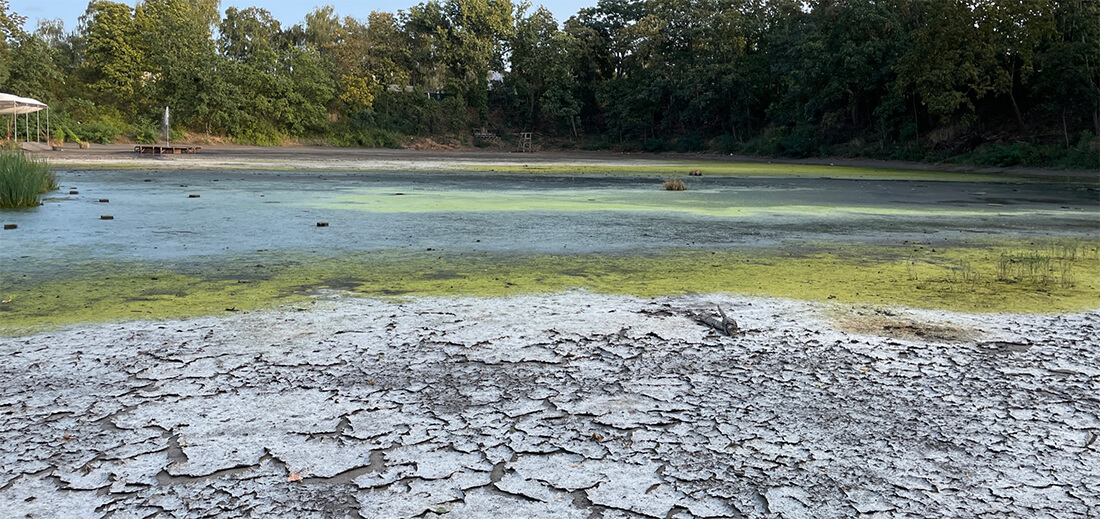
Reeds grow in the muddy sediments, frogs spawn in polluted waters, birds circle above and nest in the basin, compost piles generate heat, attract insects and fungi. The proliferation poses questions about what life forms the site enables and what it excludes. Since 2018, an association of around sixty urban practitioners at the intersection of art, architecture and ecology have reimagined the basin as a natureculture learning site (Floating 2025). Here, urban experiments and collective practices seek to foster more than human cohabitation. Importantly, this community cohabits not only with non-human beings but also inhabits a complex social space where personalities, roles, and responsibilities matter. In practice, negotiating more than human habitability has meant working through institutional relations, bureaucracies, ownership structures and political entanglements, as observed during fieldwork.
Cohabitation, in this context, becomes a process of negotiation, contestation and ongoing tension. The basin’s landlord classifies the site as a technical infrastructure, an approach that prioritises infrastructural purity and requires the regular removal of sediment and vegetation to preserve water quality. Amphibians and reeds are treated as unwanted side effects. Meanwhile, the district’s environmental office understands the basin as a conservation area and restricts human access, transforming certain areas around the reeds into a protected zone. Finally, the Floating University association, with its mandate to hybridise the site, seeks to partially unseal the ground, to foster ecological care and to challenge the binary between nature and culture, between life and decay.
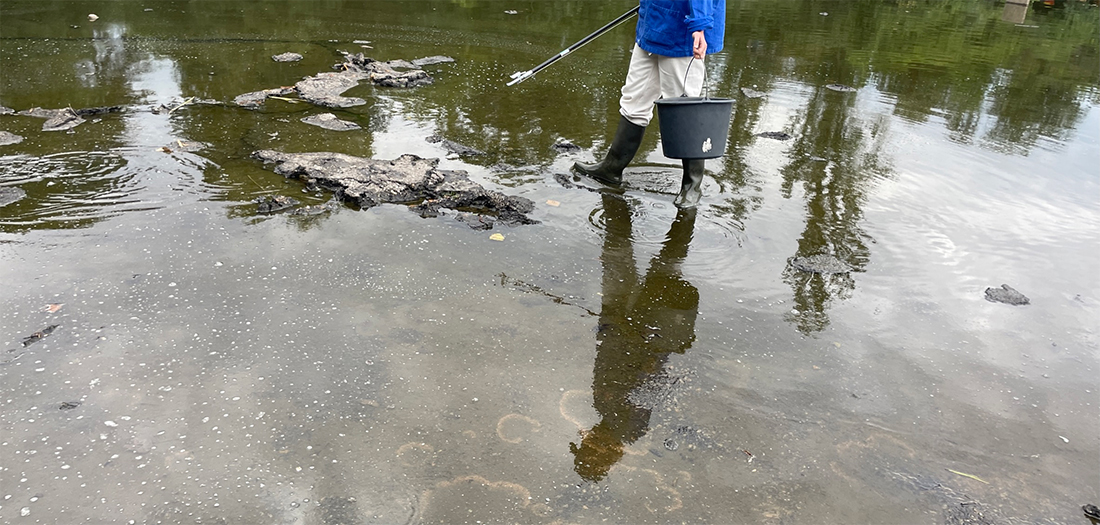
Floating University’s goal is not to restore a lost nature; rather, it proposes experimental modes of urban cohabitation under conditions of contamination. The basin has thus become a living experiment where postindustrial infrastructure and spontaneous ecologies unfold together. Habitability remains open, incomplete, unstable and shaped by the entangled agencies of humans, plants, animals and contaminants.
Outlook: Thinking from/towards the Ethnographic
From inhabiting the anthropogenic waterscape of the Spreewald to cohabiting with more than human life in the rainwater retention basin of Floating University Berlin, we engage with habitability as a contested, ambiguous concept. Thinking with the world-building entanglements of different agencies, by noticing them, following them and their effects, and attuning to them, is central to our ethnographic approach. For us, staying with the ambiguities of habitability in ethnographic analysis is also a methodology to explore political contestations. In this regard, Stacey Ann Langwick’s (2018) postcolonial study is instructive in demonstrating the “politics of habitability”. Taking practices of growing therapeutic plants in a Tanzanian community garden as her research site, Langwick focuses on how gardeners, plants and soils make and re-make each other by “experiment[ing] with ways to inhabit the toxicities that simultaneously enable contemporary life and deplete the very conditions of its ongoingness” (Langwick 2018, 418). Such ethnographic studies tie habitability to diverse questions of remembering and situate them in their political context.
Political struggles are regularly connected to histories of pollution, inequality and violence inscribed into postcolonial and capitalist modes of living with each other and with more than human beings (Liboiron 2021; Reid et al. 2024; Todd 2022; Langwick 2018; Wong 2019). They are also simultaneously connected to movements and practices that demand engagement: climate justice, indigenous, crip and anti-colonial activism, and more. The frictions in everyday practices that result can also become potential sites of creativity in a political sense, creating something unexpected yet productive, as suggested by Anna Tsing (2005).
Thinking relationally ‘with habitability’ challenges and impacts how we understand different ways of being, living, dwelling and knowing, in collaboration with more than human research partners in our field sites, and with each other (Luggauer 2025). Ethnographic moments have particular potential in directing our analytical attention to the everyday and its blurring of the distinction between the habitable and the uninhabitable. AbdouMaliq Simone’s notion of habitability as an oscillating concept provoked and inspired us to think of our ethnographic studies as investigations into how “the habitable and uninhabitable are, and can be, redescribed in terms of each other” (Simone 2016, 137). Simone maintains that neither the uninhabitable can be equated with nonlife, nor habitability with life. Building on this, we argue that habitability must not be understood in binary opposition to uninhabitability. Instead, we conceptualise it as a critical field of potentiality for more than human living and alternative ontologies of co-existence, and as a potent conceptual lens through which to examine the politics embedded in the situated practices that shape forms of habitability.
In this world, we see ourselves as academics responsible for investing in collective world-making practices that support the imagination and cultivation of possible habitable futures for the many, knowing that any form of habitability is inevitably relational, incomplete and partial. In our view, thinking with habitability enables a tentacular mode of thought, tracing partial relations across divergent cases, scales, and geographies, and connecting gendered, racialised, classed, colonial, crip, and more-than-human worlds. In a world literally on fire, the politics of habitability take shape in everyday practices that cultivate relating. We therefore encourage continuing to ask: How does habitability unfold when depicted from the situated everyday moments of struggle and negotiation? Whose lives and what ways of living are made possible or impossible? What kind of strategies, improvisations and practices of cohabitation are needed to thrive?
References
Beck, Stefan. 2008. “Natur | Kultur. Überlegungen zu einer relationalen Anthropologie.” Zeitschrift für Volkskunde 104 (2):161-199.
Bellacasa, Maria Puig de la. 2017. Matters of Care: Speculative Ethics in More than Human Worlds. 3rd edition. Minneapolis: University of Minnesota Press.
Bloom-Christen, Anna, and Hendrikje Grunow. 2024. “What’s (in) a Vignette? History, Functions, and Development of an Elusive Ethnographic Sub-Genre.” Ethnos 89 (5): 786-804.
Bourdieu, Pierre. 1979. La distinction : critique sociale du jugement. (Via Internet Archive.) Paris: Éditions de Minuit.
Bourdieu, Pierre. 1991. Physischer, sozialer und angeeigneter physischer Raum, in: Martin Wentz (Hrsg.), Stadt-Räume. Frankfurt a.M./New York.
Carson, Rachel. 1962. Silent Spring. Consumers Union, edited by Houghton Mifflin. Cambridge: Riverside Press.
Chakrabarty, Dipesh. 2019. “The Planet: An Emergent Humanist Category.” Critical Inquiry 46 (1): 1-31.
Chakrabarty, Dipesh. 2021. The Climate of History in a Planetary Age. Chicago: University of Chicago Press.
Chakrabarty, Dipesh. 2022. “Planetary Humanities: Straddling the Decolonial/Postcolonial Divide.” Daedalus 151 (3): 222–33.
Derham, William. 1721. "Astro-theology: or, A demonstration of the being and attributes of God, from a survey of the heavens." 4th ed. / W. and J. Innys, London
Ensor, Sarah. 2017. “Queer Fallout: Samuel R. Delany and the Ecology of Cruising.” Environmental Humanities 9 (1): 149-66.
Farbotko, Carol, and John Campbell. 2022. “Who Defines Atoll ‘Uninhabitability’?” Environmental Science & Policy 138: 182-90.
Floating Berlin. “Association.” Accessed September 18, 2025.
Gildersleeve, Basil L., and Lodge, Gonzales. 1903. Gildersleeve's Latin Grammar: Third Edition, Revised, and Enlarged. 3rd ed. London, England: Macmillan and Co.
Giraud, Eva Haifa. 2019. What Comes after Entanglement?: Activism, Anthropocentrism, and an Ethics of Exclusion. A Cultural Politics Book. Durham: Duke University Press.
Hamraie, Aimi. 2020. “Alterlivability: Speculative Design Fiction and the Urban Good Life in Starhawk’s Fifth Sacred Thing and City of Refuge.” Environmental Humanities 12 (2): 407-30.
Haraway, Donna. 1997. Modest_Witness@Second_Millennium. FemaleMan©_Meets_Onco MouseTM. New York: Routledge.
Haraway, Donna. 2003. The Companion Species Manifesto – Dogs, People, and Significant Otherness. Chicago: University of Chicago Press.
Haraway, Donna. 2016. Staying with the Trouble: Making Kin in the Chthulucene. Durham: Duke University Press.
Hetzel Desirée, Usée Patricia, Goldmann Till, Münch Pauline, Brill Fabio. “Begegnung mit der Spree.” Blogpost in: Flusspunkte entlang der Spree. Accessed July 30, 2025
Higgins, David. 2021. “Apocalypse/Extinction.” In The Cambridge Companion to Environmental Humanities, edited by Jeffrey Cohen and Stephanie Foote. Cambridge Companions to Literature. Cambridge and New York: Cambridge University Press.
Ingold, Tim. 2000. The Perception of the Environment. Essays in Livelihood, Dwelling and Skill. London/New York: Routledge.
Ingold, Tim. 2011a. Being Alive: Essays on Movement, Knowledge and Description. London and New York: Routledge.
Ingold, Tim. 2011b. The Perception of the Environment: Essays on Livelihood, Dwelling and Skill. London and New York: Routledge.
IPCC. 2019. Annex I: Glossary, edited by N.M. Weyer. In IPCC Special Report on the Ocean and Cryosphere in a Changing Climate, edited by H.-O. Pörtner, D.C. Roberts, V. Masson-Delmotte, P. Zhai, M. Tignor, E. Poloczanska, K. Mintenbeck, A. Alegría, M. Nicolai, A. Okem, J. Petzold, B. Rama, N.M. Weyer. Cambridge and New York: Cambridge University Press, pp. 677-702.
Laboratory: Anthropology of Environment | Human Relations (Editorial Collective). 2019. AfterPractice. Thinking through Matter(s) and Meaning Relationally, Vols. 1 and 2. Berliner Blätter 80 and 81. Berlin: Panama Verlag.
Langwick, Stacey Ann. 2018. “A Politics of Habitability: Plants, Healing, and Sovereignty in a Toxic World.” Cultural Anthropology 33 (3): 3.
Latimer, Joanna, and Mara Miele. 2013. “Naturecultures? Science, Affect and the Non-Human.” Theory, Culture & Society 30 (7–8): 5-31.
Latour, Bruno. 2005. Reassembling the Social. An Introduction to Actor-Network-Theory. Oxford: Oxford University.
Latour, Bruno. 2017. Facing Gaia: Eight Lectures on the New Climatic Regime. Translated by Catherine Porter. London: Polity.
Latour, Bruno. 2018. Down to Earth: Politics in the New Climatic Regime. New Jersey: Wiley.
Latour, Bruno and Chakrabarty, Dipesh. 2020. “Conflicts of Planetary Proportion – A Conversation.” Journal of the Philosophy of History 14 (3):419-454.
Latour, Bruno, and Peter Weibel, eds. 2020. Critical Zones: The Science and Politics of Landing on Earth. Cambridge, MA: The MIT Press.
Law, John. 2004. After Method: Mess in Social Science Research. London and New York: Routledge.
Liboiron, Max. 2021. Pollution Is Colonialism. Manchester: MNG University Press.
Luggauer, Elisabeth, and Ferdinand. 2025. Fieldwork on six legs: Ethnography as multispecies experimental collaboration. The February Journal, 05: 40–63.
Meadows, Donella H., Dennis L. Meadows, Jørgen Randers, and William W. Behrens III. 1972. The Limits to Growth: A Report for the Club of Rome’s Project on the Predicament of Mankind. New York: Universe Books.
Merleau-Ponty, Maurice. 2013. Phenomenology of Perception. London and New York: Routledge.
Merriam-Webster. 2025. “Definition of HABITABLE.” Merriam-Webster Dictionary..
Mol, Annemarie. 2002. “The Body Multiple : Ontology in Medical Practice.” Science and Cultural Theory. Duke University Press.
Oxford English Dictionary. 2025. “Habitability, n. Meanings, Etymology and More.” Oxford English Dictionary.
Pacini-Ketchabaw, Veronica, and Fikile Nxumalo. 2016. “Unruly Raccoons and Troubled Educators: Nature/Culture Divides in a Childcare Centre.” Environmental Humanities 7 (1): 151-68.
Reid, Andrea J., Deborah A. McGregor, Allyson K. Menzies, Lauren E. Eckert, Catherine M. Febria, and Jesse N. Popp. 2024. “Ecological Research ‘in a Good Way’ Means Ethical and Equitable Relationships with Indigenous Peoples and Lands.” Nature Ecology & Evolution 8 (4): 595-98.
Simone, AbdouMaliq. 2016. “The Uninhabitable? In between Collapsed Yet Still Rigid Distinctions.” Cultural Politics 12 (2): 135-54.
Star, Susan Leigh. 1991. “Power, technologies and the phenomenology of standards: On being allergic to onions.” A sociology of monsters? Power, technology and the modern world, John Law, ed. Sociological Review Monograph. No. 38, Oxford: Basil Blackwell: 27-57.
Stengers, Isabelle. 2023. Virgin Mary and the Neutrino: Reality in Trouble. Translated by Andrew Goffey. Experimental Futures: Technological Lives, Scientific Arts, Anthropological Voices. Duke University Press.
Sterly, Harald, Marion Borderon, Patrick Sakdapolrak, et al. 2025. “Habitability for a Connected, Unequal and Changing World.” Global Environmental Change 90: 102953.
Strathern, Marilyn. 1991. Partial connections. Savage: Rowman & Littlefield.
Straube, Wibke. 2019. “Toxic Bodies: Ticks, Trans Bodies, and the Ethics of Response-Ability in Art and Activist Writing.” Environmental Humanities 11 (1): 216-38.
stsing e.V. 2024. “Code of Conduct.” Accessed July 30, 2025.
Tam, Mankei. 2023. “‘Skin of the Earth’: On Soil, Collaboration, and Temporality after Fukushima.” Environmental Humanities 15 (2): 39-61.
Todd, Zoe. 2022. “Fossil Fuels and Fossil Kin: An Environmental Kin Study of Weaponised Fossil Kin and Alberta’s So-Called ‘Energy Resources Heritage.’” Antipode n/a (n/a).
Tsing, Anna Lowenhaupt. 2005. Friction: An Ethnography of Global Connection. Princeton: Princeton University Press.
Umweltbundesamt Deutschland. 2023. “Spree faces increased water shortage after coal phase-out in Lausitz region.” Press release. Accessed July 30, 2025.
Wallace-Wells, David. 2019. The Uninhabitable Earth: A Story of the Future. London: Allen Lane.
Weart, Spencer R. 2004. The Discovery of Global Warming. Cambridge: Harvard University Press.
Wong, Alice. 2019. “The Rise and Fall of the Plastic Straw.” Catalyst: Feminism, Theory, Technoscience 5: 1–12.