
Ecoterritorial Agricolonialism
Tin Wilke and Mercedes Lozano
Related terms: plantationocene, new materialism, ecosensual, affective ecology, German colonialism, South America, Wallmapu, artistic research, an-archive, pine trees, phallus, sacrifice zones.
Introduction
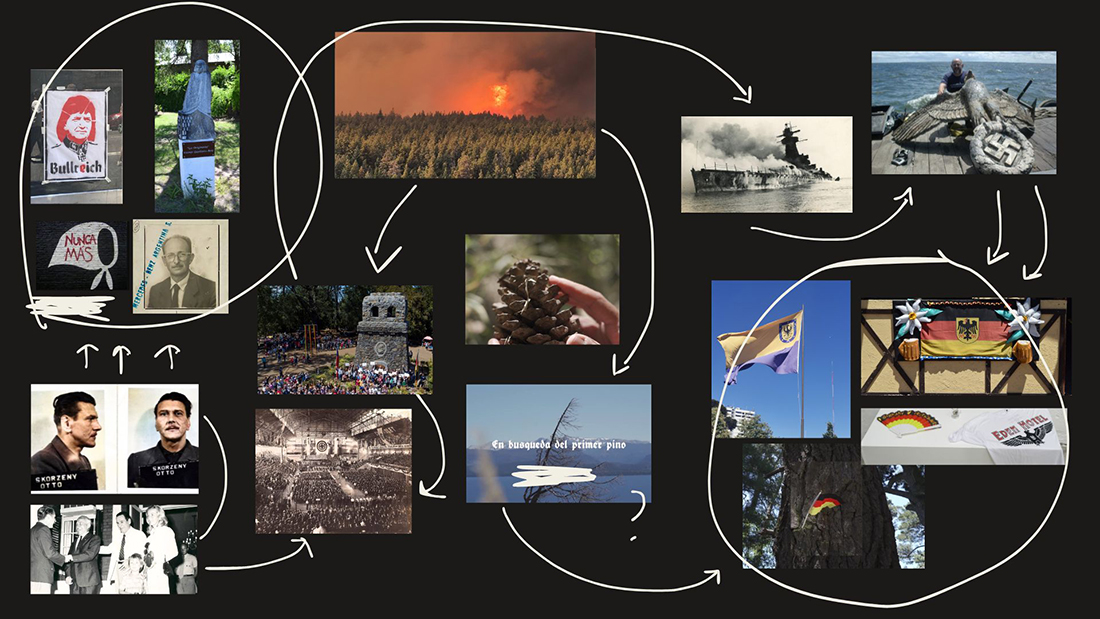
Ecoterritorial agricolonialism is a term we began shaping during our artistic research, inspired by the work of Maristella Svampa (2022,10), who has analysed the socioecological conflicts in Latin America caused by neoextractivist policies. Our project traces the historical and ecological entanglements of fascist and colonial structures through the lens of the so-called “Ratlines” (Rattenlinien in German), escape routes used by Nazi criminals after World War II who had fled Europe and found refuge, support networks, and new careers in South America, among other places.
Through speculative and documentary artistic strategies, we investigate the Nazi presence by connecting their trajectories to deeper colonial infrastructures. Drawing on video, oral histories, performative interventions, field recordings, found materials, and 3D scans, we create encounters between ourselves and the multiple agents of the territory, developing from Arturo Escobar’s notion of a “territory of life”: an entangled space of memory, affect, and resistance (Escobar 2014, quoted in Svampa 2019a, 128). Through our embodied practice, we map the penetrative, extractivist, agricultural practices and settler logics that reshaped ancestral lands into sacrifice zones and environmental collapse. By emphasising not only the sensory and emotional imbrications but also the ironic and the kitsch, we aim to reveal the lines that connect fascist colonialist structures in the present day. By foregrounding these relational modes of knowing, we aim to co-create situated knowledge that is attentive to ecological grief, multispecies complicity, and the colonial residues inscribed in the landscape.
Our research provokes complex questions about memory, accountability, and colonial histories. Approaching the topic through the dual perspectives of a German and an Argentine artist and researcher enables a layered, critical engagement with both historical complicity and local silences.
German colonisation in the South
When Hitler came to power, Argentina and Chile already had large German communities which had been growing since the nineteenth century, during the consolidation of nation-states in Latin America (Ojeda-Ebert 1984, 25-42). The campaigns of the “Pacification of the Araucanía” in Chile (1861–1883) and the “Conquest of the Desert” in Argentina (1878–1885) aimed to seize Indigenous lands, enabling state expansion and industrial development. These military efforts were instrumental in the occupation of Wallmapu, legitimising genocidal violence against the Mapuche and other Indigenous peoples, and paving the way for European immigration, industrial extractivism and capital investment (Correa 2021, 69-78). “Wallmapu” refers to the ancestral territory of the Mapuche people, encompassing regions in southern Chile and Argentina, commonly known as Patagonia. It is not merely a geographic space but also a deeply rooted cultural and spiritual concept central to the Mapuche worldview. Wallmapu embodies a complex notion of resistance, as the Mapuche continue to fight for the recovery of their lands, which have been systematically appropriated through colonisation, state expansion, and capitalist extraction. The concept of Wallmapu remains vital in contemporary Mapuche struggles for territorial autonomy, self-determination, and the protection of their cultural heritage against ongoing forms of dispossession and exploitation.
The immigration and colonization projects were designed to increase the proportion of the white population, expanding the territorial rule of the white oligarchy, and obtaining a skilled workforce, thus leveraging the so-called “civilizing power” of European immigrants against the Indigenous population and spreading the narrative of an “unpopulated Chile” ready for the colonialists to be settled (Correa 2021, 23-24, 69-70). Deforestation of native forests and the plantation of industrial pine trees are closely linked to this colonial project. These monocultures, as Françoise Vergès argues, are symptoms of a colonial capitalist order that sees land as an object of domination and commodification, erasing its ancestral and ecological complexity (Vergès 2023, [xii-xvii]). A parallel can be seen in occupied Palestine, where Zionist settlers planted pine trees to attract Europeans after the 1948 Nakba, destroying over 500 Palestinian villages together with their biodiverse balance and thus making the land vulnerable to forest fire outbreaks, just as it is the case in the South of Chile and Argentina. The Jewish National Fund (JNF) collected money to buy land and plant European trees, mainly pines, that would overwrite Palestine’s identity, claiming it was planting forests on “barren, desolate lands”, a colonial narrative that was applied widely in the so-called Americas (Askar and Palestine Peace Collective 2025). The city of San Carlos de Bariloche, situated in the Argentinian Patagonia and a centre of tourism and commerce in that region, was founded by a German-Chilean coloniser called Carlos Wiederhold, who crossed the Andean mountains from what is today Chile and opened the first business, “La Alemana,” which later grew into a town. “Bariloche” in the Mapuche language means “people from the other side of the mountain.” Thus, the name of the city translates to “Karl who crossed the mountains” (Bariloche.Org n.d.).
After the Second World War, Nazi officials used the ratlines escape routes to flee to South America. Many found refuge in Argentina and Chile, where longstanding German diasporic communities provided shelter and networks of support. These communities remained deeply tied to German national identity, maintaining close commercial, industrial, and educational connections to Germany. The geographical remoteness from the Global North and the inaccessibility of these areas created a haven for Nazi fugitives. Over time, many of these ex-officials became embedded in local elite circles, occupying positions of influence and authority (Levenda 2013, 142-44; Steinacher 2011, 211-36). This hidden continuity gained a new, overt dimension in 1973, when leading figures within the German-Chilean municipalities played a direct role in helping to plan and execute the military coup of September 11. The fascist Junta led by Augusto Pinochet, responsible for three decades of brutal repression, autocratic neoliberalism and territorial exploitation, received unwavering support from the German-Chilean Bund (DCB), which disseminated pro-junta propaganda and lobbied for foreign investment to back its neoliberal reforms, which were inspired by the Chicago School and carried out by the so-called Chicago Boys. The Chicago School, an economic ideology and set of theories established by a group of economists based at the University of Chicago, promoted free-market principles and minimal state intervention, ideas that laid the foundation for neoliberal policies worldwide. The term “Chicago Boys” refers to Latin American economists trained in this tradition, many of whom played key roles in implementing structural reforms during the military dictatorships of the 1970s and 1980s, particularly under “Operation Condor”, a joint operation by South American intelligence services to criminalise and go after the opposition and left-leaning actors. These policies enabled the large-scale exploitation of land and resources, often prioritising foreign investment and market liberalisation over local sovereignty and environmental protections. The ideological and material entanglements of these German elites with the Pinochet regime form a key link in the chain of historical continuities we trace between European fascism and Latin American authoritarianism.
The phallus pine tree: context and methodology
Led by our activated sensorium and sharpened awareness, we followed traces through archives and oral history and came across the information about who had probably planted the first pine tree in the once native forest ecosystem of the South. In 1890, German botanists such as Rodolfo Philippi and Arturo Junge promoted the first pine plantations on the coasts of southern Chile, while the first 200 grams of seeds of the Pinus Insignis arrived in Concepción. Junge, an agricultural engineer who always maintained close relations with the German colony in Chile, also initiated the construction of what became the only “Bismarck Tower” in South America. (Various Bismarck Towers were built, mostly on (former) German territory and its colonies, to glorify the late German Reich Chancellor Otto von Bismarck; they reached further ideological significance during the Nazi regime). The Bismarck Tower in Concepción stands out as the only one in Latin America and in a Land that didn't officially belong to the German Empire, making the German colonial aspirations on that territory very clear. This monument was built on the hills of Cerro Caracol, a central and strategic area of Concepción where the first pine trees were planted. In the Concepción area and Chilean Patagonia, it is the pine monoculture plantations and the pulp industry that turn ecosystems into sacrifice zones. This term refers to a geographical area disproportionately burdened by environmental degradation due to the concentration of extractive or industrial activities. These zones are often inhabited by marginalised or socioeconomically disadvantaged communities who bear the brunt of pollution and ecological harm. Justified in the name of economic growth or energy production, sacrifice zones exemplify systemic environmental injustice and the unequal distribution of environmental risks and benefits. This German pine, promoted by Junge, may mark the beginning of what we describe as ecoterritorial agricolonialism by German settlers in the south of Chile.
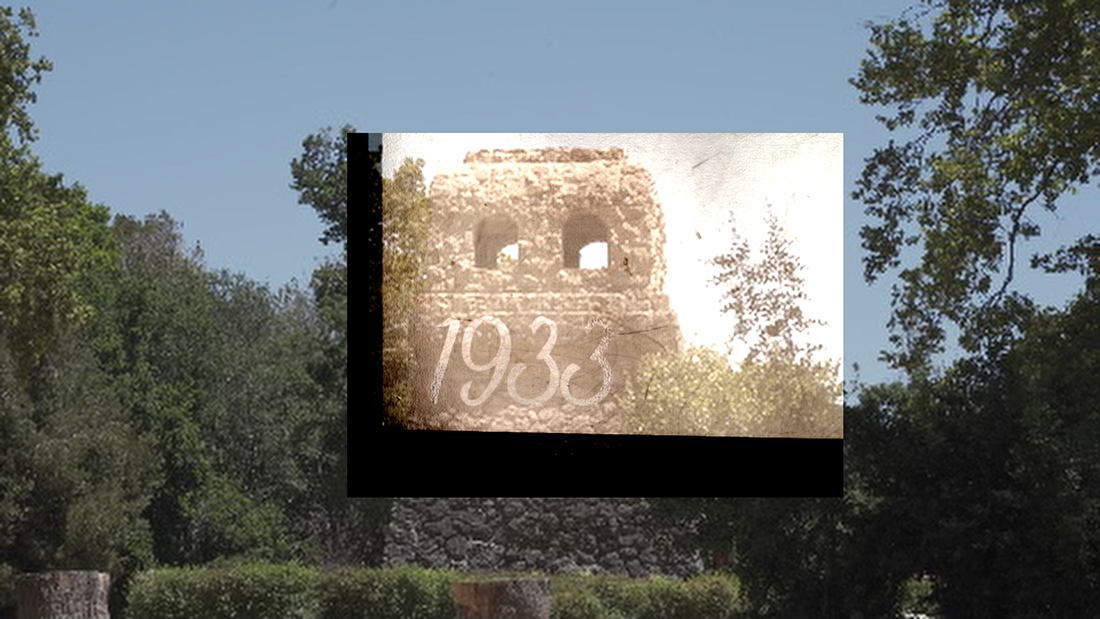
By the 1970s and 1980s, especially under Pinochet’s regime, the forest sector was restructured around export-oriented neoliberal policies, which fueled the massive growth of pine monocultures. This expansion generated major environmental and social conflicts due to the displacement of rural populations, depletion of water sources, loss of biodiversity, soil acidification, and increased vulnerability to fires and pests. These consequences highlighted the contradictions between conservation rhetoric and the extractivist reality of industrial forestry (Camus, Castro and Jaksic 2014, 370-80). They illustrate the ways in which colonial projects were pursued not only through territorial occupation but also through landscape interventions like forest policies and the extraction of natural resources. Those projects evolved into a model of economic development deeply rooted in exploitive and neoliberal ideologies, with ongoing ecological and social repercussions today.
Nowadays, the socio-environmental conflict in Latin America is intensifying. On the surface, these conflicts are about access to and control over natural resources and territories within a context of extreme power asymmetries. What is most relevant to our project is the deeper, epistemic conflict that these struggles reveal: a clash between radically different conceptions of territory, nature, and environment as well as worldviews and notions of what development, progress, and democracy can mean.
Svampa argues that large-scale industrial megaprojects frequently reconfigure entire territories. These interventions not only disrupt existing economic and social structures but also threaten democratic practices by bypassing participatory mechanisms and marginalising affected communities (Svampa, 2022,1-2). The imposition of such projects tends to exacerbate internal divisions and fuels cycles of criminalisation and repression against resistance movements, which are often framed as obstacles to progress. Nonetheless, such movements, rooted in territorial, ecological, and communal logics, articulate alternative civilizational visions that contest the dominant model of extractivist development and centralised, authoritarian governance.
¿Dónde está Julia Chuñil?
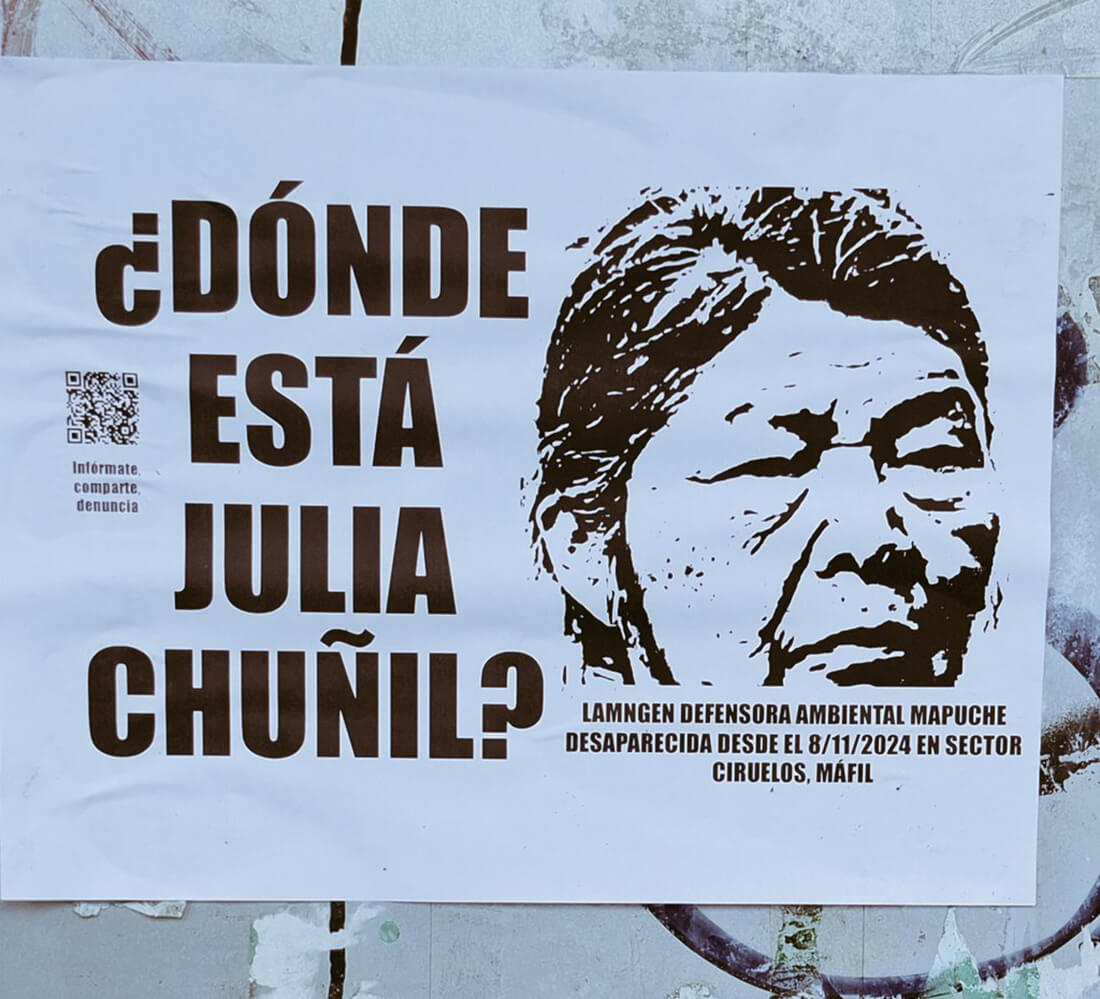
A recent case that reflects the persistence of colonial violence by German settlers is the forced disappearance of Julia Chuñil, a Mapuche environmental activist, on November 8, 2024. Chuñil was known for her defence of native forests and Mapuche ancestral territories. One of the main suspects in her disappearance is Juan Carlos Morstadt Anwandter, a forestry businessman of German descent, who had reportedly threatened her on several occasions, demanding she leave the land. Before she went missing, Chuñil warned her family by saying, “If something happens to me, you know who it was” (Figueroa 2025). Her efforts were focused on land officially recognised as ancestral by the National Corporation for Indigenous Development, the same institution which had controversially transferred ownership of the territory to Morstadt. This transaction later became the subject of a legal complaint.
According to her family, Chuñil had experienced months of harassment and threats due to her work protecting approximately 900 hectares of native forest in the commune of Máfil. Despite the seriousness of the case, the investigation has been marked by delays and a lack of transparency, with important documents reportedly kept confidential by authorities. Recently, however, an audio recording was leaked in which Morstadt allegedly admits to having burned Chuñil’s body, a revelation that directly points to the main suspect and has intensified public pressure on judicial authorities. This case illustrates the ongoing presence of colonial power structures in the agricultural sector and reveals how a privileged landowning oligarchy continues to exert influence across political and economic spheres, often avoiding legal consequences for their actions.
One of the guiding principles in this investigation was the notion that progressivism left the path open to fascism. This phrase speaks to a critical paradox in recent Latin American history, particularly evident in countries like Argentina, but also across the Atlantic, where far-right and neofascist movements are gaining ground. This perspective resonates with the analysis of Svampa, who warns that although authoritarian tendencies may not be permanent, and egalitarian forces continue to resist through labour unions, territorial movements, feminist and LGBTQ+ activism, as well as Indigenous and environmental struggles, the political landscape has become increasingly precarious (Svampa 2019b, 24). The current post-progressive moment is defined by rising inequality, social fragmentation, and punitive discourses, all of which echo the neoliberal backlash of the 1990s while also pointing to deeper societal shifts that normalise exclusionary ideologies once believed to be overcome.
This period of crisis thus calls for a reexamination of dominant narratives of linear progress and development. The Bolivian sociologist and historian Silvia Rivera Cusicanqui has long emphasised the importance of recovering ancestral Indigenous epistemologies as tools for challenging these hegemonic frameworks. She argues that we are entering a more aggressive stage of colonial-capitalist domination, in which the state and corporate power rely on subtler strategies, offering limited social benefits in return for the passive acceptance of extractive practices and territorial loss. Beneath the discourse of Latin American progressivism, Rivera Cusicanqui identifies a persistent colonial logic that reproduces the very power structures it claims to dismantle (Cusicanqui 2018, 12). While her contributions have been central to decolonial thought, María Galindo reminds us that such decolonial frameworks risk overlooking how colonial domination is inscribed and perpetuated through the disciplining of bodies and the regulation of sexuality, calling for a more explicitly embodied account of decolonisation (Galindo 2022, 143-44). Taken together, these perspectives underscore that resistance requires not only the recovery of memory and alternative ways of knowing but also an insistence on the centrality of the body for any decolonial practice.
What role do the arts play in the collective processing of historically and politically disturbing and complex events?
What is the responsibility of culture in relation to the repetition of history and the rise of oppressive authoritarian forces around the world?
How to reveal colonial violence through artistic gestures without reproducing it?
An-Archivic Interventions
“The irreparable is not an end. Ruins are not ruination, though this is not to celebrate the aesthetics of ruin.” (Verges 2023, xv)
From the pine monoculture plantations of Wallmapu, the territory called Patagonia today, to the dry riverbeds of Córdoba province in central Argentina, our artistic practice traces the enduring afterlives of plunder across layered geographies. These environments are living documents of colonial expansion, authoritarian governance, and environmental collapse. Our approach does not seek to restore a coherent narrative or romanticised notion of pure ancestral lands but instead listens to what remains fragmented, visceral, and often silenced.
We counter the hegemonic official archives with their intentional gaps and imperial narratives by assembling scattered elements that resist dominant frameworks of historical truth and create an-archival (Zielinski 2015) fragments of local ecologies. Rather than seeking coherence through state narratives, our method emerges as a constellation of gestures, materials, and presences that counter the archival, legal, and commonsensical frameworks of sovereign states and that resist the linear supremacy of the official narratives. Our method focuses on finding the (over)living traces of colonisation that mark the territory (Yildrim 2023, 2-3). By applying and inverting affective ecological methods (Meyers 2012), we work with the gesture of “despatriarcalizar” with a series of interventions and performances. The term “despatriarcalizar” enacts an embodied disruption of entrenched patriarchal structures. As an active challenge to traditional hierarchical dualisms, this gesture advocates for more equitable forms of relationality, the recognition of multiplicity, and the revalorization of knowledges and practices subalternized by patriarchy. This perspective is embedded within broader discussions on decolonisation, the construction of alternative civilizational models, and the overcoming of hegemonic logics. It offers a critical lens through which to address the intersections of gender, colonialism, and historical memory, encouraging a reimagining of social and political relations grounded in solidarity and justice. Together with oral histories, field recordings, three-dimensional scans, found materials, and documentary fragments, they form a speculative ecological archaeology, animated by memory, the body, relations, and resistance.
At the core of our method is bodily engagement with territory, plants, animals, and communities. This process emerges from what we conceptualise as eco-sensual contact across multispecies actualities within the afterlives of colonialism. Through a methodology of montage, we seek to illuminate minor events, fleeting affects, and contingent entanglements, foregrounding not only the sensory and emotional, but also the ironic and the kitsch as critical registers. By attending to these dimensions, we aim to trace the persistent continuities between contemporary material landscapes and the structural legacies of fascist and colonial violence. Influenced by the author and Indigenous activist Ailton Krenak, we approach the territory not as a resource but as a body that grieves, remembers, and speaks (Krenak 2021, 27-30). Artistic research in this sense becomes a relational encounter, an eco-sensing with the material reality and local histories. The land bears the traces of trauma, just as it offers ways of reconnecting to collective memories.


We incorporate sexuality and ironic strategies of refusal against the heteropatriarchal logics of empire. At the same time, we propose a confrontation with colonial violence, both historical and current, reading the marks of extractivism in the forests and rivers with our bodies. Our practice confronts systematic forgetting by insisting on the endurance of traces and remembrance as an ongoing praxis.
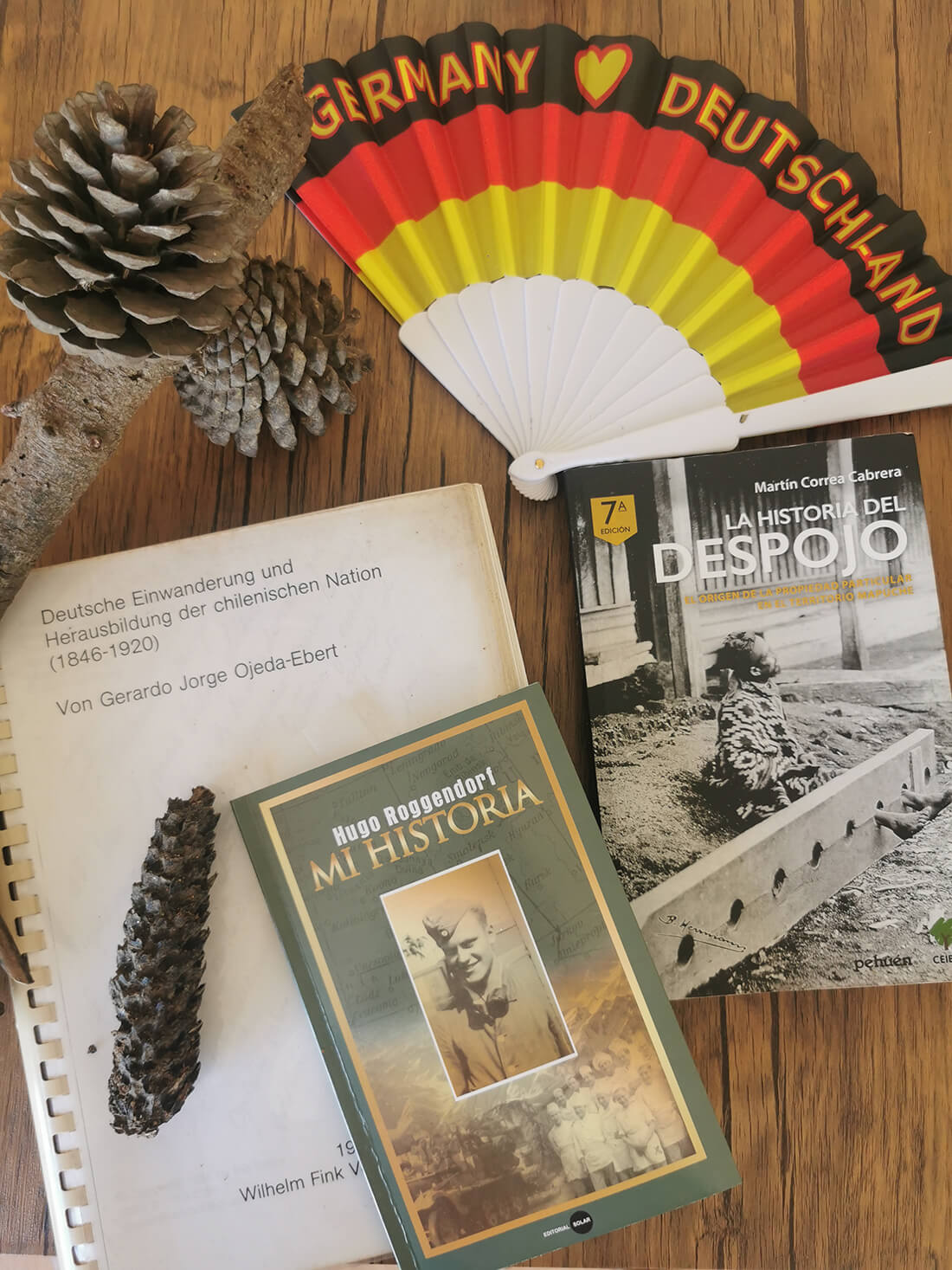
We place residues from pine plantations with kitschy tourist souvenirs from alpine-style towns that reproduce and celebrate sanitised imaginations of “German heritage” in Argentina. These juxtapositions reveal the ornamental surfaces that mask deeper structures of violence. Kitsch, in this context, becomes a critical device as a way of disturbing the smooth aesthetics of nation-building with discomfort and absurdity. National colours on flags and products, when placed against forest residues and extractive waste, reveal the entangled colonising practices in the exoticising tourist gaze. Irony becomes a tool not for detachment but for sharp attention to the contradictions within the construction of cultural memory. We engage with what is hidden in plain sight and in collective memories as traces of fascism, settler colonialism, and ecological ruin that continue to shape both landscapes and collective consciousness.

These interventions respond to the call by Donna Haraway (2016) to “stay with the trouble”, who, following Hannah Arendt, warns against the dangers of unthinking. Thinking, for us, is an act of cultivating forms of remembrance that resist the linearity of progress and the banality of fascism that we find within neocolonial structures.
Active Memory of the Colonial Past as a Tool for Epistemic and Political Reconstitution
The reactivation of the past responds to the urgent need to subvert linear, Eurocentric narratives of history, which have served as the ideological foundation of the national State’s notion of modernity, development, and progress. As Cusicanqui asserts, the past gains particular relevance when understood in light of collectively lived and suffered experiences. In her words, it is about “recovering the sense of relevance that the past acquires in light of these collectively experienced and suffered events” (Cusicanqui 2018, 41), which allows for the reconstitution of ancestral Indigenous epistemes not as archaeological remnants, but as living political categories capable of “shaking the present and awakening us from the lethargy into which we have fallen” (Cusicanqui 2018, 46).
The speculative nature of historiography as a realm of narratives and myths is crucial here. Hegemonic accounts often produce deliberate voids, privileging white and colonial interpretations of history while erasing others, ultimately reaffirming national narratives that encourage the rise of reactionary forces, such as today’s new right. We oppose the simplicist notion of time conceived as a horizontal line ordered by cause and effect, which is foundational to Western historical thought as a colonial epistemology. In many non-Western and Indigenous cultures, time has been conceptualised in cyclical, spiral, or layered forms, allowing for alternative readings of history. Questioning the horizontality of historical time means questioning the very structures that uphold colonial and capitalist forms of power.
This gesture does not aim to idealise the ancestral statically, but to actively reinterpret it as a dialectical image, drawing on Walter Benjamin’s (Benjamin 1974, 14-15) notion of Urzeit (homogeneous, empty time) and its disruption through Jetztzeit (now-time). Rather than viewing history as a linear, progressive continuum, this approach highlights the capacity of certain historical moments to erupt into the present, revealing ruptures and possibilities that challenge dominant, positivist temporalities. Memory, then, becomes both a metaphorical and practical tool of struggle: it interrupts the modern fetishes of development, allowing the past to speak in the present and opening up alternative horizons beyond the capitalist imagination.
In the same spirit, Cusicanqui warns us against the dangers of oversimplification, which often reproduces the myth of the “noble savage” and the ideal of a harmonious “natural economy.” (Cusicanqui 2018, 90-99) Instead, she proposes an ethics of complexity and simultaneity “to move within several worlds at the same time” (Cusicanqui 2018, 109), navigating diverse ecological niches without losing ethical direction. This kind of praxis, rooted in popular languages and practices, is are way of cultural, political, and symbolic survival and creation in urban contexts marked by degradation and multiple forms of oppression.
Working with active memory is not an exercise in the past for the sake of the past, but an intervention from the present toward possible futures. The colonial past, when reactivated as living memory, not only illuminates the genealogy of our oppressions but also serves as a seed for worlds yet to come.
Coda
As mentioned above, “Ratlines” refers to a net of escape routes used by Nazi war criminals and collaborators from Europe who fled to South America. Two primary routes developed independently but eventually collaborated. The first went from Germany to Franco´s regime in Spain, then to Argentina. The second led through Rome with the Vatican, the Red Cross, as well as US intelligence being involved, as some Catholic functionaries accepted working with the Nazis to fight the common enemy of Bolshevism (Steinacher 2011, xx-xxiv, 159). While fewer than 300 Nazis were convicted in the Nuremberg trials, Brazil received between 1,500 and 2,000 Nazi war criminals, and between 500 and 1,000 settled in Chile. However, the largest number of up to 5,000 individuals, including 800 members of the SS, relocated to Argentina.
After the Second World War, several countries used these escape networks to shelter Nazi officials for the purpose of continuing scientific and technological developments. One prominent example is Juan Domingo Perón, who served three terms as President of Argentina. He brought Nazi officials into the country to recruit military personnel and specialists such as engineers, technicians, and pilots to advance national development. In July 1949, Perón even issued a general amnesty for foreigners who had entered the country illegally or under false identities. Long-established German settler communities welcomed these new arrivals, including many national socialists (Steinacher 2011, 211-36).
During the military dictatorships imposed in South America with the support of the CIA, and responsible for the deaths and disappearances of over one million people, fugitive Nazi criminals contributed to military strategies and torture methods. They served as spies in multiple intelligence services, including local agencies, the BND, and the CIA. Many were also employed as engineers in subsidiaries of German companies such as Mercedes-Benz, Krupp, and Volkswagen. Others disseminated right-wing propaganda through publications such as Der Weg (The Path), published in Buenos Aires from 1948 to 1957. In the German school curriculum, the Nazi regime is generally addressed only up to its official collapse in 1945. Connections to the BND and the CIA, which collaborated with Nazi criminals, as well as the impact of these structural continuities on the current political climate, are largely absent from public education.
Under the code name Operation Condor, led by the United States, the intelligence agencies of the six South American countries (Argentina, Chile, Paraguay, Uruguay, Bolivia, and Brazil) collaborated during the 1970s and 1980s on the persecution and elimination of leftist political forces and opposition. Like many Nazis in Europe before them, most members of the Juntas remained unpunished and died in their homes.
The resurgence of fascism is once again visible today in figures such as Javier Milei, the current president of Argentina, and José Antonio Kast, a presidential candidate and active member of the German community in Chile. Meanwhile, in Germany, the party Alternative for Germany (AfD) openly espouses fascist positions and continues to gain electoral strength while centrist parties in the government pass deeply racist anti-immigration and rearmament bills. In some federal states, the AfD has recently become the most powerful political force, even though it is officially classified as far-right and monitored by the domestic intelligence service.
References
Askar, Miral, and The Palestine Peace Collective. 2025. “When Trees Become Weapons: The Burning Legacy of Colonial Forests.” Palestine Peace Collective’s Substack, May 1, 2025.
Bariloche.Org n.d., “El porqué de San Carlos de Bariloche…”.
Benjamin, Walter. 1974. “Über den Begriff der Geschichte (On the Concept of History).” In Gesammelte Schriften Vol. 1-2, edited by Rolf Tiedemann und Hermann Schweppenhäuser, 691-704. Frankfurt a.M.: Suhrkamp.
Camus, Pablo, Sergio A. Castro and Fabian Jaksic. 2016. “Historia y política de la gestión forestal en Chile a la luz del pino insigne (Pinus radiata).” En Invasiones biológicas en Chile: Causas globales e impactos locales, editado por Fabian Jaksic et al., 357-92. Santiago: Ediciones Universidad Católica de Chile.
Correa, Martín. 2021. La historia del despojo: El origen de la propiedad particular en el territorio mapuche. Santiago: Pehuén Editores y Ceibo Ediciones.
Escobar, Arturo. 2008. Territories of Difference: Place, Movements, Life, Redes. Durham, NC: Duke University Press.
Figueroa, Natalia. 2025. “A 100 días de su desaparición: ¿dónde está Julia Chuñil?” LATFEM, February 18, 2025.
Galindo, María. 2022. Feminismo bastardo. Santiago de Chile: Editorial Universidad de Santiago de Chile.
Haraway, Donna. 2016. Staying with the Trouble: Making Kin in the Chthulucene. Durham, NC: Duke University Press.
Krenak, Ailton. 2021. Ideias para postergar el fin del mundo (Ideias para adiar o fim do mundo). Translated by María José Sanz. Madrid: Errata Naturae.
Levenda, Peter. 2013. Ratline: Soviet Spies, Nazi Priests, and the Disappearance of Adolf Hitler. San Francisco: Ibis Press.
Myers, Natasha. 2012. “Involutionary Momentum: Affective Ecologies and the Sciences of Plant/Insect Encounters.” Differences 23(3): 1-43.
Myers, Natasha. n.d. “How to Grow Livable Worlds: Ten (not-so-easy) Steps.” Manuscript.
Ojeda-Ebert, Gerardo Jorge. 1984. Deutsche Einwanderung und Herausbildung der chilenischen Nation (1846–1920). Munich: Fink.
Rivera Cusicanqui, Silvia. 2010. Ch’ixinakax Utxiwa: Una reflexión sobre prácticas y discursos descolonizadores. Buenos Aires: Tinta Limón.
Rivera Cusicanqui, Silvia. 2018. Un mundo ch’ixi es posible. Buenos Aires: Tinta Limón.
Steinacher, Gerald. 2011. Nazis on the Run: How Hitler’s Henchmen Fled Justice. Oxford: Oxford University Press.
Svampa, Maristella. 2019a. Neo-Extractivism in Latin America: Socio-Environmental Conflicts, the Territorial Turn, and New Political Narratives. Elements in Politics and Society in Latin America. Cambridge: Cambridge University Press, October 17, 2019.
Svampa, Maristella. 2019b. “Lo que las Derechas traen a la región latinoamericana entre lo político y lo social; nuevos campos de disputa.” July 2019.
Svampa, Maristella. 2022. “Conflictos socioambientales, giro ecoterritorial y alternativas en América.”
Vergès, Françoise. 2023. Foreword, In War-torn Ecologies, An-archic Fragments, edited by Umut Yıldırım. Berlin: ICI Berlin Press.
Yıldırım, Umut, ed. 2023. War-torn Ecologies, An-archic Fragments. Berlin: ICI Berlin Press.
Zielinski, Siegfried. 2015. “AnArcheology for AnArchives: Why Do We Need – Especially for the Arts – A Complementary Concept to the Archive?” Journal of Contemporary Archaeology 2(1): 1-147.