
Ecomorphosis
Related terms: adaptation, assemblage, climate change, co-creation, more-than-human, resilience
Reimagining Recovery as Co-creation
What happens when a tropical island’s coral reefs, mangrove forests, and human communities simultaneously reshape themselves in response to catastrophic environmental change? In everyday usage, we might describe this as “recovery” or “adaptation.” Still, such terms inadequately capture the profound entanglement of social and ecological transformation that unfolds in the aftermath of environmental crisis. Recent syntheses depict environmental humanities as an arena that couples critical historicization of ecological harm with actionable, multispecies, justice-centred practice (Emmett and Nye 2017). As a term, ‘ecomorphosis’ builds on this trajectory by treating ecological systems as co-agents in adaptation design and governance.
“Ecomorphosis” derives from the Greek words oikos, meaning “house” and/or “economy” (Oxford Reference n.d.), and morphosis, meaning “forming” or “shaping” (Merriam-Webster n.d.). It describes the ongoing, dynamic process of reciprocal transformation between human and more-than-human entities in response to environmental change. As a means to escape anthropocentrism, “house” here refers not to human dwellings but to the planetary home that we all living entities share and collectively inhabit. “Economy” denotes the human household’s management of value, labour, and materials within institutions. “Ecology” signifies the household of nature – the interlinked flows of energy, matter, and relationships that constitute ecological systems and sustain multispecies communities. Building on Walker’s genealogy, this concept of oikos reveals the shared yet fragmented roots of ecology and economics, those “estranged twin sciences” (Walker 2020, 34) whose divergent modern trajectories shape how resilience and adaptation are framed in policy and practice. Unlike conventional understandings of adaptation that position humans as central actors responding to external environmental pressures, an approach through ecomorphosis recognises that landscapes, ecosystems, species assemblages, and human communities undergo simultaneous and mutually constitutive transformations. As an approach, ecomorphosis highlights how our collective planetary home undergoes continuous reconfiguration through the dynamic interactions of all inhabitants, extending the notion of oikos beyond physical structures to encompass the complex webs of relationships that sustain life across various scales.
Operationalising the notion of ecomorphosis entails significant redefinitions of key concepts in environmental thinking, shifting beyond individualistic frameworks toward relational understandings of environmental change. “Adaptation” shifts from isolated responses to environmental pressure toward “relational adaptation”: the ongoing adjustment of relationships within multispecies assemblages, where transformation emerges not through independent responses by separate entities but through “iterative and collaborative processes involving diverse types of expertise, knowledge and actors to produce context-specific knowledge and pathways towards a sustainable future” (Norström et al. 2020, 183). Similarly, “resilience” transforms into an ability to develop new capacities for flourishing under changed conditions, manifesting not through restoration of prior configurations but through the creative emergence of novel social-ecological arrangements that enhance collective survival (Ammar et al. 2025). “Flourishing” expands beyond human wellbeing to encompass “mess-making as a force for resistance” (Hogarth and Hankin 2023, 340). This encompasses the cultivation of conditions that enable diverse forms of life to develop their capacities in mutually supportive ways, as demonstrated through emergent collaborations between human communities that adapt their strategies and ecological systems that develop new structural and functional arrangements. This certain form of “multispecies justice challenges the ontological separation of human worlds and the worlds of Earth others, and it challenges us to bring forth more-than-human agencies, lives, and concerns” (Celermajer et al. 2025, 53).
When synthesised together, these redefinitions suggest fundamentally different approaches to environmental challenges that work with, rather than against, ecological processes. Instead of imposing solutions from purely human standpoints, this framework advocates for designing interventions that enhance, rather than suppress, the adaptive capacities of multispecies assemblages (Blanco-Wells 2021). This reorientation opens possibilities for environmental practices that are simultaneously more ecologically attuned and more socially just, acknowledging that human and more-than-human flourishing are fundamentally interdependent (Fitz-Henry 2021).
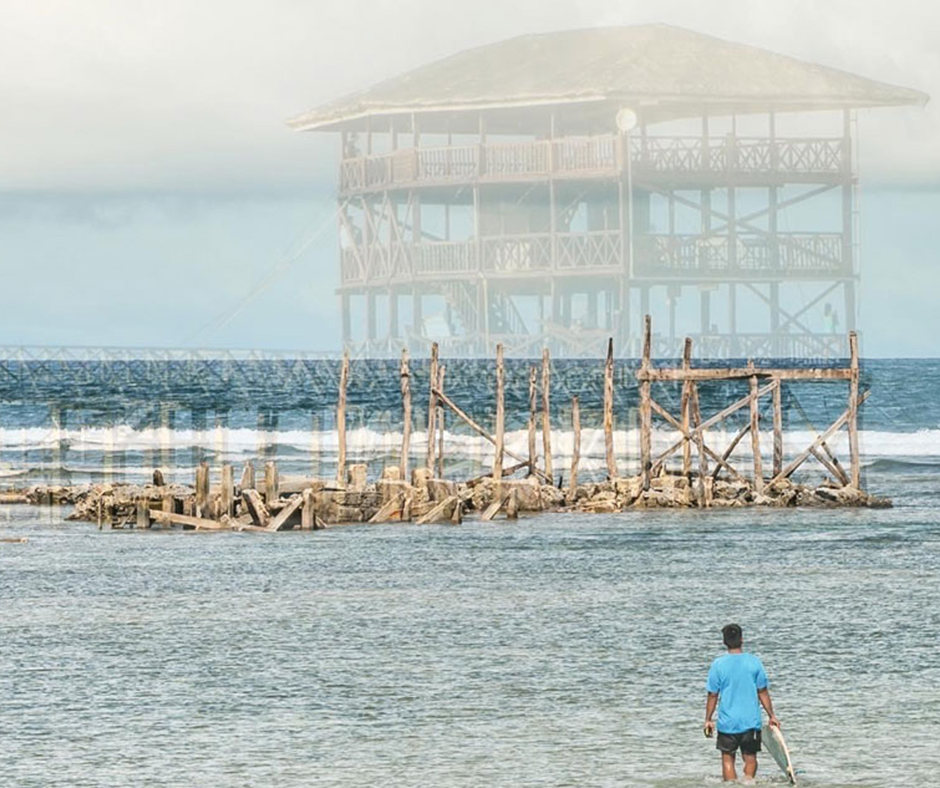
Nine days before Christmas in 2021, super typhoon Odette (international name: Rai) struck Siargao Island, a prominent ecotourism and surfing destination in the Philippines, with sustained winds exceeding 195 kph and gusts reaching 270 kph. This perturbation – part of the always-ongoing adaptive processes that characterise life in the tropical Pacific – triggered cascading transformations across the island’s social-ecological systems. The super typhoon precipitated widespread devastation: nearly 80 per cent of the island’s structures, including residences, resorts, and community facilities, were either severely damaged or destroyed. Coastal settlements were inundated by storm surges that swept away homes and livelihoods. At the same time, the collapse of critical infrastructure, including power, water, and communications, left residents in a state of acute deprivation. Even designated evacuation centres failed to provide adequate refuge, compelling evacuees to seek shelter in the most structurally sound remnants available. The environmental toll was equally profound, as Odette’s force dislodged massive corals, reducing live coral cover in some areas, and stripped mangrove forests, which nonetheless played a crucial role in mitigating further loss of human life and property. The typhoon displaced hundreds of thousands of people and fundamentally altered both the physical and social landscape of Siargao. Yet rather than representing a singular catastrophe, this event catalysed forms of ecomorphosis already latent within Siargao’s coastal ecotone, i.e., within the dynamic boundary zone where terrestrial and marine ecosystems interpenetrate (Kark 2013).
The dominant paradigm in disaster response treats environmental crises as external shocks to otherwise stable human and natural systems. This approach, embedded in humanitarian frameworks and development policies, assumes that recovery means returning to pre-disaster states through technical interventions, infrastructure rebuilding, and economic “restoration.” Such thinking perpetuates what Kathryn Yusoff calls the “geologic colour line” (2018, 3) – the assumption that environmental change affects a passive landscape upon which human actors must act. This status quo perspective fails to recognise that environmental changes like super typhoon Odette do not simply impact pre-existing systems but actively participate in ongoing processes of world-making. In this context, ‘resilience’ refers to the capacity of coupled social-ecological systems to absorb disturbances, reorganise, and continue to develop – up to and including transformation when prior regimes are untenable – rather than simply bouncing back to pre-event conditions (IPCC 2022).
True enough, on Siargao, the landscape does not simply return to a prior state of equilibrium; rather, it becomes a site of dynamic co-creation, where the boundaries between social and ecological restoration are continually negotiated. In the months following Odette, the island’s coral reefs began developing new structural arrangements, with surviving coral polyps forming unprecedented alliances with resilient algae species. Simultaneously, local fishing communities adapted their practices to work with these emerging reef configurations rather than attempting to restore previous fishing grounds. The gradual resurgence of mangrove forests, with some regrowing in entirely new locations where storm surges had deposited seedlings, occurred alongside community decisions to relocate settlements and develop new forms of coastal creativities. These parallel transformations illuminate the profound entanglement of human recovery efforts with the regenerative capacities of the more-than-human.
As communities mobilised to rebuild their lives and livelihoods, the island’s ecological systems simultaneously initiated their own forms of renewal. This parallel unfolding suggests that the work of adaptation is inherently co-creative, involving a continuous back-and-forth between human intention and the relatively autonomous, adaptive responses of ecosystems. Rather than asking how humans can restore Siargao to its pre-typhoon state, ecomorphosis as an approach calls for different questions: How do the island’s coral reefs, coconut trees, mangrove forests, and human communities negotiate new forms of collective flourishing? What emerges when reconstruction is understood as multispecies collaboration rather than human intervention?
Such questions demand a rethinking of the frameworks that have traditionally guided disaster response and recovery. Against conventional approaches that privilege human agency and technical solutions, ecomorphosis foregrounds how more-than-human actors actively participate in shaping the trajectory of transformation. Recognising this broader field of agency opens up new possibilities for more just, inclusive, and sustainable forms of reconstruction. Mimi Sheller (2020) explores how recovery efforts can move beyond conventional models, noting that “principles of just recovery suggest that there are better ways to go about reconstruction after un/natural disasters, whether caused by earthquakes, by hurricanes, by climate change, or ultimately by the slow violence of coloniality and neoliberal austerity” (Sheller 2020, 64).
Methodologies for Multispecies Engagement
Staying with the trouble on Siargao means tracing the unexpected, situated connections through which human and more‑than‑human lives compose livable futures together – following how mangrove regrowth patterns, shifting reef structures, and emergent livelihood practices co-produce conditions for multispecies flourishing without presuming a single pathway or pace. This is the pragmatics of “complex worlding” (Haraway 2016, 116): attending to difference in ecologies, economies, species, and lives while taking responsibility for shaping enabling conditions, not for imposing uniform solutions. A compositionist stance clarifies the method: becoming and transformation proceed by actively composing a common world out of heterogeneous parts – human practices, coral recruitment, sediment regimes, mangrove regeneration, governance experiments – accepting that what emerges is necessarily “fragile, revisable, and diverse composite material” (Latour 2010, 474), to be maintained and reworked over time.
Latour provides a generative lens for rethinking transformation as an unfinished, collective process of creating worlds that are simultaneously provisional and interdependent. For Latour (2010), compositionism rejects both the modernist belief in preexisting universals and the relativist retreat into isolated pluralities, calling instead for an active engagement in composing common worlds from heterogeneous and unstable materials. This framework aligns productively with the biological concept of ecomorphosis, first formulated by Paul Cassagnau (1955), who demonstrated how morphological adaptation is not a fixed reaction to environmental stress but a dynamic, systemic reconfiguration that allows species to reassemble their forms and functions in response to continually shifting conditions. Cassagnau’s insight that stress can catalyse creative morphological recomposition rather than mere survival adaptation prefigures later expansions of the concept by Fjellberg (1998) and Bonfanti et al. (2023), whose studies revealed the cellular and ecological mechanisms through which organisms enact transformation under duress. In these works, morphological plasticity emerges as a form of distributed agency across systems, suggesting that transformation is not confined to individual organisms but occurs within networks of relational adaptation. These biological insights extend ecomorphosis beyond, grounding it in the material processes through which life continually reconstitutes itself. Read this way, Siargao’s post‑Odette landscape is not a return to a pre‑disaster state but an ongoing composition where interventions aim to hold together workable relations across land–sea interfaces, rather than to restore an idealised stasis. The island’s transforming environment thus exemplifies a fragile yet resilient synthesis of stress, adaptation, and creative assembly.
Ecomorphosis as an approach challenges anthropocentric perspectives by accentuating that more‑than‑human entities are not only sources of knowledge for human adaptation but are themselves enduring profound harm and actively developing their own strategies of resilience (Brown 2018; Kipnis 2015). The corals rebuilding Siargao’s reefs, and the mangrove seedlings establishing new forests, embody adaptive practices developed over millions of years of evolution and call for institutions that acknowledge nonhuman agency without collapsing differences in kinds of agency (Robles 2024). These species demand recognition not as resources for human use but as participants in collective processes of environmental transformation, a move consistent with proposals for the “democratic representation of nonhumans” (Brown 2018, 31) in political life and with climate justice arguments that ethical and political obligations extend to damaged places and ecosystems alongside human communities (Sultana 2022). Parallel developments in environmental law – especially rights‑of‑nature and ecosystem personhood – provide concrete legal architectures that institutionalise such recognition for ecosystems (Pain and Pepper 2021).
Equitable Futures in a Changing Climate
Environmental humanities have shifted from primarily critical diagnostics toward types of praxis that integrate justice, multispecies ethics, and co-creative methods across scholarship, policy, and arts, while interrogating anthropocentrism and colonial political ecologies (Christensen, Heise, and Niemann 2017; Emmett and Nye 2017; Glotfelty and Fromm 1997). Building on this turn, ecomorphosis frames equitable futures in a changing climate as design problems to be solved with ecological processes and more‑than‑human agencies, so that adaptation advances multispecies flourishing while redressing structural inequality in the places most exposed to harm.
The path toward multispecies flourishing cannot ignore the structural inequities that make certain communities and ecosystems more vulnerable to environmental change. Recent research in environmental justice reveals how colonial histories, extractive economic relationships, and unequal access to resources create differential vulnerabilities to environmental perturbations (Sultana 2022). On Siargao, accelerated tourism development and the accompanying real estate speculation had fundamentally restructured the island’s social-ecological geography well before Odette’s arrival. The unchecked expansion of big resorts and expatriate-oriented accommodations triggered cascading processes of coastal gentrification, as prime beachfront properties were consolidated by external investors while land values and rental costs escalated beyond local affordability. The spatial reorganisation of the island thus created a landscape of differential vulnerability: international tourism infrastructure occupied the most geographically protected and economically valuable coastlines, while local communities found themselves increasingly marginalised to infrastructurally underserved areas where their capacity for environmental adaptation was simultaneously constrained by economic displacement and enhanced exposure to climatic hazards.
Ecomorphosis approaches offer pathways toward more equitable futures precisely by foregrounding the agency and adaptive capacities of marginalised communities and degraded ecosystems. The notion of ‘ecomorphosis’ offers a compelling imperative for the environmental humanities, urging scholars to extend their work beyond critique and toward active, embodied engagement with the more-than-human world. This concept insists that research and practice must evolve to recognise the agency of ecological systems, advocating for methodologies that transcend “passionate immersion in the lives of the nonhumans being studied” (Tsing 2011, 19). Such an approach requires a fundamental shift in perspective: ecological systems are not passive backgrounds for human action, but dynamic participants in the ongoing processes that shape our shared environments (Dunlop et al. 2024).
Regenerative and adaptive responses to environmental challenges become increasingly possible when these interconnections among all forms of life are recognised and valued. An ecomorphic approach encourages scholars and practitioners to design interventions and policies that work in concert with ecological processes, rather than imposing solutions from a purely human standpoint. Such strategies might include collaborative restoration projects, participatory research with local communities and nonhuman stakeholders, “one where nature and people are not merely viewed as separate and independent, but as intertwined and co-dependent” (Welden, Chausson, and Malinidis 2021, 973).
The pathway that ‘ecomorphosis’ illuminates leads toward more sustainable and equitable futures, where humans are attuned to their role as participants in the ongoing transformation of the planet. Rather than seeking mastery over nature, this perspective embraces participation, reciprocity, and shared responsibility. Such a shift holds the promise of fostering communities and ecosystems that are better equipped to navigate the uncertainties of the Anthropocene, cultivating resilience that is distributed across the full spectrum of life.
References
Ammar, Yosr, Riikka Puntila-Dodd, Maciej T. Tomczak, Magnus Nyström, and Thorsten Blenckner. 2025. “Novelty, Variability, and Resilience: Exploring Adaptive Cycles in a Marine Ecosystem under Pressure.” Ambio 54 (11): 1885.
Blanco-Wells, Gustavo. 2021. “Ecologies of Repair: A Post-Human Approach to Other-Than-Human Natures.” Frontiers in Psychology 12.
Bonfanti, Jonathan, Paul Henning Krogh, Mickaël Hedde and Jérôme Cortet. 2023. “Ecomorphosis in European Collembola: A Review in the Context of Trait-Based Ecology.” Applied Soil Ecology 182 (February).
Brown, Mark B. 2018. “Speaking for Nature: Hobbes, Latour, and the Democratic Representation of Nonhumans.” Science & Technology Studies 31 (1).
Cassagnau, Paul. 1955. “L’influence de la température sur la morphologie d’Hypogastrura purpurescens (Lubbock), Collembole Poduromorphe.” Comptes rendus des séances de l’Académie des Sciences 240: 1483-85.
Celermajer, Danielle, Anthony Burke, Stefanie Fishel, Erin Fitz-Henry, Nicole Rogers, David Schlosberg, and Christine Winter. 2025. Institutionalising Multispecies Justice. Cambridge: Cambridge University Press.
Christensen, Jon, Ursula K. Heise, and Michelle Niemann. 2017. The Routledge Companion to the Environmental Humanities. London: Routledge.
Dunlop, Thomas, Danial Khojasteh, William Glamore, Milad Haghani, Daniela Rizzi, Peter Greve, and Stefan Felder. 2024. “The Evolution and Future of Research on Nature-Based Solutions to Address Societal Challenges.” Communications Earth & Environment 5 (1): 132.
Emmett, Robert S., and David E. Nye. 2017. The Environmental Humanities: A Critical Introduction. Cambridge, MA: MIT Press.
Fitz-Henry, Erin. 2021. “Multi-Species Justice: A View from the Rights of Nature Movement.” Environmental Politics 31 (2): 338–59.
Fjellberg, Arne. 1998. The Collembola of Fennoscandia and Denmark, Part I: Poduromorpha. Fauna Entomologica Scandinavica 35. Leiden; Boston: Brill.
Glotfelty, Cheryll, and Harold Fromm. 1996. The Ecocriticism Reader: Landmarks in Literary Ecology. Athens: University of Georgia Press.
Haraway, Donna J. 2016. Staying with the Trouble: Making Kin in the Chthulucene. Durham: Duke University Press.
Hogarth, Hannah, and Charlotte Hankin. 2024. “Mess-Making as a Force for Resistance: Reimagining Environmental Educational Research for Multispecies Flourishing.” Australian Journal of Environmental Education 40 (2): 340–358.
IPCC. 2022. Climate Change 2022: Impacts, Adaptation and Vulnerability. Edited by H. O. Pörtner, D. C. Roberts, M. Tignor, E. S. Poloczanska, K. Mintenbeck, A. Alegría, M. Craig, S. Langsdorf, S. Löschke, V. Möller, A. Okem, and B. Rama. Contribution of Working Group II to the Sixth Assessment Report of the Intergovernmental Panel on Climate Change. Cambridge: Cambridge University Press.
Kark, Salit. 2013. “Effects of Ecotones on Biodiversity.” Encyclopedia of Biodiversity, 2nd ed., 142–148.
Kipnis, Andrew B. 2015. “Agency between Humanism and Posthumanism: Latour and His Opponents.” HAU: Journal of Ethnographic Theory 5 (2): 43–58.
Latour, Bruno. 2010. “An Attempt at a 'Compositionist Manifesto'.” New Literary History 41 (3).
Merriam-Webster Dictionary. n.d. “Morphosis.” Merriam-Webster Dictionary.
Norström, Albert V., Christopher Cvitanovic, Marie F. Löf, Simon West, Carina Wyborn, Patricia Balvanera, Angela T. Bednarek, et al. 2020. “Principles for Knowledge Co-Production in Sustainability Research.” Nature Sustainability 3 (3): 182–190.
Olivieri, Matias. [Composite photo of destroyed Siargao tower]. Photograph. In “LOOK: Lensman makes composite photo of destroyed Siargao tower,” by Hernel Tocmo, January 14, 2022. News.abs-cbn.com.
Oxford Reference. n.d. “Oikos.” Oxford Reference.
Pain, Nicola, and Rachel Pepper. 2021. “Can Personhood Protect the Environment? Affording Legal Rights to Nature.” Fordham International Law Journal 45 (2): 315–375.
Robles, Whitney Barlow. 2024. “On Nonhuman Agency.” The Journal of Interdisciplinary History 54 (3): 305–321.
Sheller, Mimi. 2020. Island Futures: Caribbean Survival in the Anthropocene. Durham: Duke University Press.
Sultana, Farhana. 2022. “Critical Climate Justice.” The Geographical Journal 188: 118–124.
Tsing, Anna Lowenhaupt. 2011. “Arts of Inclusion, or, How to Love a Mushroom.” Australian Humanities Review, no. 50: 5–22.
Walker, Jeremy. 2020. More Heat than Life: The Tangled Roots of Ecology, Energy, and Economics. Singapore: Palgrave Macmillan.
Welden, Emily A., Alexandre Chausson, and Marina S. Melanidis. 2021. “Leveraging Nature-Based Solutions for Transformation: Reconnecting People and Nature.” People and Nature 3 (5): 966–977.
Yusoff, Kathryn. 2018. A Billion Black Anthropocenes or None. Minneapolis: University of Minnesota Press.