
The Predicament of Privilege: Inequality and Ambivalence in Contemporary Scandinavian Culture
Book launch.
Join us for a celebratory drink marking the publication of The Predicament of Privilege: Inequality and Ambivalence in Contemporary Scandinavian Culture.
After a brief presentation of the book, Nina Cramer and Mikkel Krause Frantzen will offer responses after which we will continue with an informal celebration. The launch is hosted by the Nordic Models research cluster and the Dept. of Arts and Cultural Studies; Cecilie Ullerup Schmidt will moderate the event.
All are welcome.
About the book
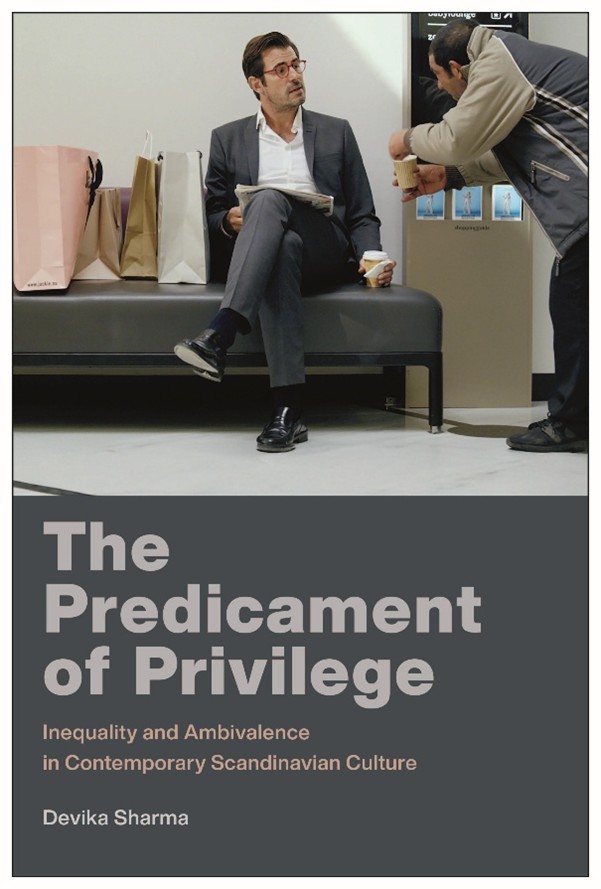 The predicament of privilege is the awkward yet ordinary experience, or accusation, that one’s global privilege is a problem. In the Scandinavian societies, this predicament raises variants of the same fundamental question: Is this okay? Is it okay, for instance, to go on holiday to Greece in the middle of a refugee crisis? Is it okay to buy fair trade products? Is it okay, or is it hypocritical, to support a humanitarian organization with 100 Norwegian kroner a month? Is it okay to hire a Romanian cleaner? Is my compassion for poor populations elsewhere okay, or is it a sign of my sense of moral superiority? Is it okay to donate your old clothes, or are you then just using the global South as the “garbage bin for the bad conscience of the rich countries,” as suggested by the Ghanian beach monitor Joe Ayesu? Is it even okay to ask questions like these, or is it indulgent navel- gazing?
In The Predicament of Privilege: Inequality and Ambivalence in Contemporary Scandinavian Culture (University of Washington Press), cultural studies scholar Devika Sharma (UCPH) argues that we live in a historical moment where the Nordic middle classes have gotten a sense of living at the expense of others—and that the predicament of privilege is a sensibility central to contemporary Scandinavian cultural life. Is this okay? is the fundamental question structuring Scandinavian priv-ilege sensibility. In explicating this question, this book is divided into four parts, each of which engages with one subfield of the okay and the not okay: Is it okay to feel like this? Is it okay to look at this? Is it okay to (ac)count like this? Is it okay to critique in this way? These four subfields—ways of feeling, seeing, (ac)counting, and critiquing—are significant cultural practices. They are also critical topics in modern cultural theory, with which this study engages deeply.
Map of South Campus
View directions.
View on map of the Faculty of Humanities - South Campus.
View map of South Campus (pdf).