
LOOKING LOW – methodological challenges in engaging art beyond established models for value and meaning
A seminar anchored in two art historical research projects located at the University of Copenhagen and the University of Lund
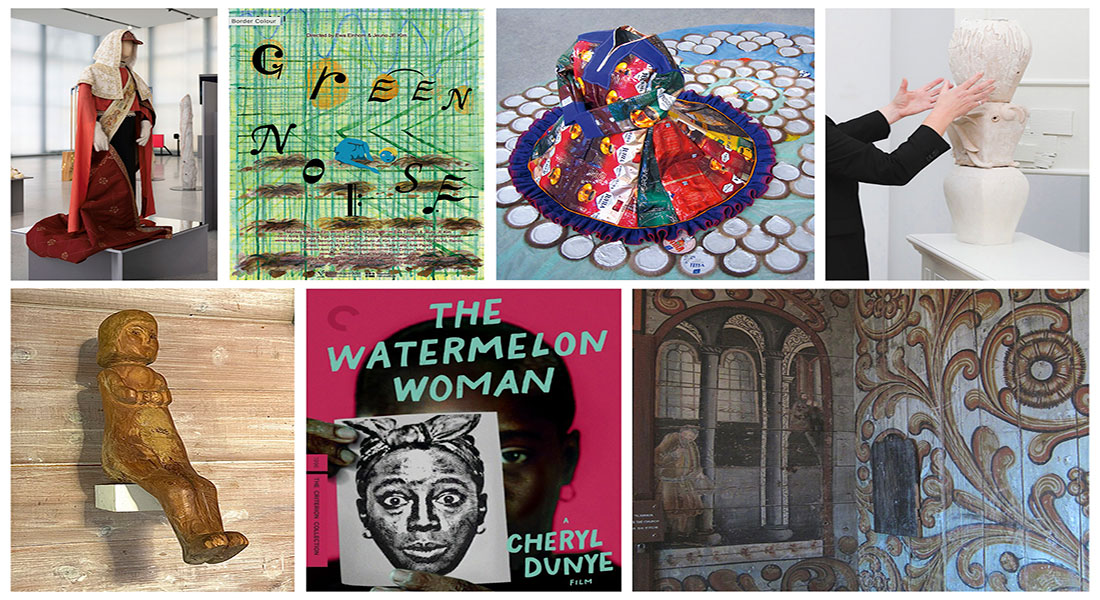
Images, clockwise from top left: I Call it Art, Nasjonalmuseet for kunst, arkitektur og design. Photo: Frode Larsen; Jeuno JE Kim & Ewa Einhorn, Green Noise, film poster, 2026; Outi Pieski, Gollegákti/Golden Coat, 2006; Jenny Grönvall, becoming ecru, 2023. Photo: Robin Rådenman; Rosemaling from Luster, Sogn; Cheryl Dunye, The Watermelon Woman, film poster, 1996; Sculpture by Julia Nylund.
Should our engagements with cultural works always be guided by value judgments of what is perceived as “good” or “interesting”? How may the employment of other epistemological standards, change how stories of art are written, presented, or enacted?
Historically the field of art history has established its epistemic boundaries through a rigorous selection of objects defined by the establishment of a canon. The latter has been defined by notions of quality, teleological formalist development and ethnocentric ideology to create a division between what is and is not art. Lately this narrative of a canon has been rightly criticised for its limitations, yet the challenge of how to engage with the multifaceted aesthetic material historically defined as being not-canon remains. What heightens this challenge is that the methodological and conceptual frameworks of art history are in themselves reflective of this canon-centred thinking.
The seminar LOOKING LOW – methodological challenges in engaging art beyond established models for value and meaning directs attention to these challenges connected to method and methodology in the study of - and work with - art that historically have been deemed “uninteresting,” “backwards,” “delayed,” or of “low quality”. With a particular focus on objects often categorized as “folk-art,” “amateur-art,” “peripheral-art” “craft,” or “ethnographic objects,” the symposium invites scholars, curators, and artists to share methodological difficulties, as well as possibilities, connected to their specific practises.
Programme
| 11:00-11:30 | Tonje Haugland Sørensen & Ellen Suneson: Introduction |
| 11:30-12:00 |
Avnnas Muitala Mo Galggat Bargat" - A Sámi methodology of Shape and Form Liisa-Rávná Finbog/Rámuavuol Liisa-Rávdná, Curator of Indigenous Art, MUNCH Dr. Finbog is a Sámi Indigenous scholar, duojár, author, and curator whose work explores Sámi aesthetics, materiality, and the politics of indigeneity. For this talk, Finbog will focus on the art of Sámi artist John Savio (1902–1938), examining his approach to shape, form, and material through the Sámi principle avnnas muitala mo galggat bargat—“the material tells you how to work.” Drawing on the concept and practice of duodji, Finbog explores how Savio’s woodcuts and paintings can be understood not simply through the lens of Nordic modernism, but through Sámi ways of relating to materials, land, and making. Using Savio’s practice as a case study, the talk will consider how Sámi aesthetic principles and epistemologies can inform the development of a Sámi methodological framework for art historical inquiry, and how such a framework might shift the terms through which Sámi art and artistic practices are understood. |
| 12:00-12:30 |
On Artistic Freedom in Craft. Or the unlimited freedom of being underestimated Johanna Rosenqvist, Professor in Art History, Linnaeus University, Växjö Drawing on her extensive study of craft, Rosenqvist provides an important overview of how certain research subjects have been received and often overlooked within the discipline of art history. In this paper, Rosenqvist puts pressure on methodological possibilities and challenges central to the study of art that do not conform to traditional art-historical frameworks. |
| 12:30-13:30 | Lunch |
| 13:30-14:00 |
A story of Harry – landscapes, art hierarchies and a Norwegian aesthetic concept? Tonje Haugland Sørensen, assistant professor in Art History, Copenhagen University 20th century Norway possessed a thriving popular art scene where various painters, all lacking academic training, produced a considerable amount of oil paintings sold by mail order, door-to-door salesmen and travelling art dealers. The majority of these images were landscapes, often reminiscent of 19th century national romantic landscapes, and while no exact number exists for how many were created it seems plausible that over 50.000 paintings were made, circulated and sold. While an obviously thriving image culture the works of this popular art phenomenon has, and largely remains, derided by the art establishment. In this presentation I will focus on this phenomenon by relating the story of the Stranda painters in the 1950’s and how they became labeled as a threat to the aesthetic sensibilities of the nation. However, building on this I will ask what do we do with these paintings? How should they be understood? And is it possible to understand and the discourse surrounding them by combining them with the Norwegian aesthetic concept of “Harry” – a colloquial term that started as a reference to things deemed uneducated, provincial and lacking sophistication, but which can also mean down-to-earth, unpretentious and even popular. |
| 14:00-14:30 |
Clashes with Canonicity: One Art Historian’s Struggle Kerry Greaves (she/her), Associate Professor of Art History, Department of Arts and Cultural Studies, University of Copenhagen Greaves’s research is concerned with absences, oversights, and structural blindspots in modern and contemporary Nordic art and its histories. Her most recent project was Feminist Emergency: Women Artists in Denmark, 1960-Present, which considered the cultural conditions of women artists and feminist art in the region and resulted in the publication Transformative Feminisms: Nordic Art in the Transcultural Present (De Gruyter 2026). Another publication includes Model Collapse: European Contemporary Art in a Time of Democratic Crisis (Manchester University Press 2025), which investigates the precarious relationship between art and democracy since the 1990s. For the seminar, Greaves will discuss her current research in the problematics and paradoxes of canonicity and canon formation and how these might be used productively in art history today, which a special focus on experiences and insights from the classroom and students. |
| 14:30-15:00 |
Transatlantic and Transmodern: The collaboration between William H. Johnson and Holcha Krake in the 1930s Anna Vestergaard Jørgensen, project researcher and curator, SMK – The National Gallery of Denmark Jørgensen is Principle Investigator for the project More-than-Nordic-Modernisms: A Postcolonial History of Modern Art in the North ca. 1900–1945 (2026-30) which explores artists, artworks, and collections that have been peripheralized because they did not fit established ideas of what counted as “Nordic” or “modern.” Its purpose is to challenge narrow and nation-centered accounts of modern art in the Nordic region by showing how art from this period was shaped by global movement, colonial entanglements, and cultural exchange. For LL, Jørgensen will particularly focus on the collaboration between African American painter William H. Johnson and Danish textile artist Holcha Krake in the 1930s, while reflecting on methodologies to approach peripheralized art histories. |
| 15:00-15:30 |
I called it art Geir Haraldseth, curator at the National Museum in Norway Haraldseth co-curated the inaugural exhibition «I Call it Art» with Randi Godø at the National Museum in Norway in 2022. The exhibition showed works by 147 contemporary artists based in Norway, all of whom were not represented in the museum collection. Who has been excluded from the collection and why? For LL, Haraldseth will share some reflections from the process, the reception, and speculate on how to exhibit this complex web of values. |
| 15:30-15:45 | Coffee |
| 15:45-16:15 | Panel conversation and open discussion |
| 16:15-17:00 |
Tonje Haugland Sørensen & Ellen Suneson: Concluding remarks |
| 10:00-10:15 | Tonje Haugland Sørensen & Ellen Suneson: Introduction |
| 10:15-10:45 |
Borderland – looking at the peripheralized. Julia Björnberg and Anna Johansson, curators at Malmö Konstmuseum and two of the founders of Flatlands–Network for Artistic Research of Scania. The exhibition Borderland (2024) brought together an unprecedented selection of Scanian landscape paintings from the collections of Malmö Konstmuseum and Ystads konstmuseum, spanning the period 1850–1950, presented alongside contemporary works from the collections and newly commissioned art.This presentation will focus on these paintings in relation to nationalistic ideas of “Swedishness” and art historiography. Further on, Johansson and Björnberg will discuss the curatorial framework and how Borderland highlighted the intersection between historical landscape painting and contemporary art practices with a focus on national identity, cultural policy, and cultural heritage. |
| 10:45-11:15 |
Constructions of backwardness and delay Ellen Suneson, Postdoc in Art History, Lund University Within art historical narratives, art from places far removed from major cultural centres is often treated as less important, less innovative, or simply "belated." This presentation discusses methodological perspectives on the study of art and cultural expressions that do not fit within established narratives of what is considered "good" or "important" art. Suneson suggests ways of writing about art that co-produces knowledge with artists by centring oral history as a method for (re)articulating previously largely overlooked narratives about art’s histories. |
| 11:15-11:45 |
Doomsday in Krabstadt Jeuno JE Kim, visual artist and study leader of BFA Education, The Royal Danish Academy of Fine Arts Kim and Ewa Einhorn are an artist duo exploring myths related to "Norden." Their ongoing transmedia project, Krabstadt (2012-present), includes animated films, digital games, performances, sculptures, and an art school for weary teachers and students. Krabstadt is an Arctic city where Nordic countries send their unwanted people, flora, and fauna. Kim presents their latest film, "Green Noise.” As temperatures rise in Krabstadt, residents strive to meet Sustainable Growth Goals. However, plants go on strike, demanding degrowth policies and attacking human art. |
| 11:45-12:15 |
When they go high, I go low Mats Wikström, artist living in northern Sweden with an interest in art outside the conventional art infrastructure (the low art he considers the highest) Wikström does not regard himself as a curator in the usual sense but has, alongside his own artistic practice, curated folk art at Havremagasinet in Boden, Luleå Art Hall, Norrbotten’s Museum, and “his own” Råneå Biennials and Råneå Art Hall. The starting point of this interest was an encounter with Julia Nylund’s work in the late 1990s: a Fjäll cattle calf and what later, when Wikström visited her in Markusvinsa in the Torne Valley, turned out to be a self-portrait. Wikström are drawn to art inspired by folk art expressions, such as that of Klara Kristalova and Björn Kjelltoft. This kind of (low) art might have informed his own practice, encouraging a greater sense of freedom in his artistic approach. |
| 12:15-13:15 | Lunch |
| 13:15-14:00 | Panel conversation and open discussion |
| 14:00-14:15 |
Tonje Haugland Sørensen & Ellen Suneson: Concluding remarks |
The seminar is organized by art historians based at the University of Copenhagen and Lund University. In different yet interconnected ways, Tonje H. Sørensen and Ellen Suneson engage with art and visual expressions that, for various reasons, have remained at the margins of traditional art historical inquiry. Sørensen is PI of Norwegian Wood: Extraction Landscapes, Art and Visual Culture (Novo Nordisk Foundation), while Suneson is PI of Constructions of Backwardness and Delay: A Methodological Inquiry into Oral Histories in the Peripheries of Art (Mads Øvlisen Postdoctoral Fellowship, Novo Nordisk Foundation). The seminar Looking Low has grown out of a collaboration between these projects and has been made possible through funding from CEMES.
Contact: Tonje.sorensen@hum.ku.dk.
Map of South Campus
View directions.
View on map of the Faculty of Humanities - South Campus.
View map of South Campus (pdf).