
EX-Land/Scapes
Seminar exploring the hierarchies, narratives, and strategies shaped by and shaping extraction landscapes.
Environmental humanities have in recent years focused increasingly on the extraction and circulation of resources. Examining the material properties and the infrastructural networks central to their circulation has allowed for increased understanding of the travel of resources and -in extension hereof- the landscapes as sites of extraction. But what of the people inhabiting such landscapes? What does it mean to live in areas defined by extraction?
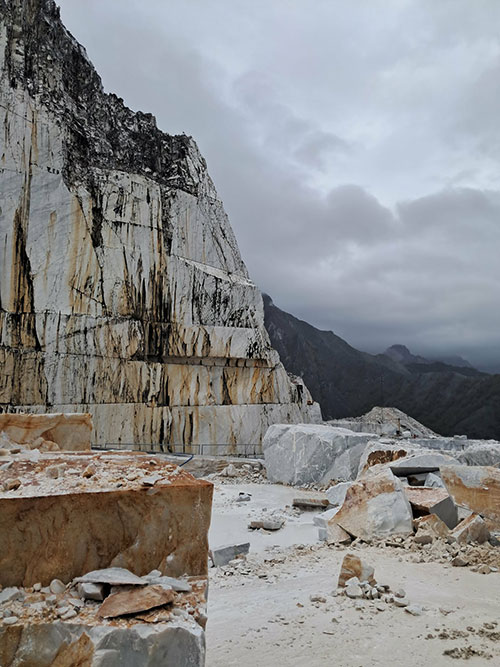
For the people who dig coal, cut marble or chop lumber, extraction is more than processing a resource: It’s a livelihood shaped by a cultivated landscape. And in most cases, people lived in landscapes long before they were turned into sites of extraction, cultivating and reshaping local identities around mining activities, which are sometimes initiated by foreign interests. When the extracted minerals, logs, and metals have long since been transported off and circulated away, these people remain on the land from which the resources were mined. Shifting focus from the resources to the social and cultural identities shaping around sites of extraction, the seminar Ex-Land/Scapes raises the often-overlooked question of what it means to live in these landscapes defined by human activities.
Through an interdisciplinary approach the seminar seeks to explore the hierarchies, narratives, and strategies shaped by and shaping extraction landscapes. The seminar thus explores the socio-cultural and socio-natural effects of extraction: Which stories, traditions, rituals, and works of art shape such communities? And what can we learn about our relationship to landscape more generally by studying societies and cultures defined by extraction? Raising these questions, the seminar wishes to challenge the prevalent notion of such landscapes as so-called “scars” in the land or places emptied of the materials that were seen as giving them value. The point is not to dismiss or overlook the often-destructive processes of extraction, but rather to emphasize extraction landscapes as lived-in lands and its communities shaping around remembering, re-scribing or simply forgetting such activities.
For more information about the event, contact organisers Tonje Haugland Sørensen (tonje.sorensen@hum.ku.dk) or Amalie Skovmøller (skovmoeller@hum.ku.dk).
Map of South Campus
View directions.
View on map of the Faculty of Humanities - South Campus.
View map of South Campus (pdf).